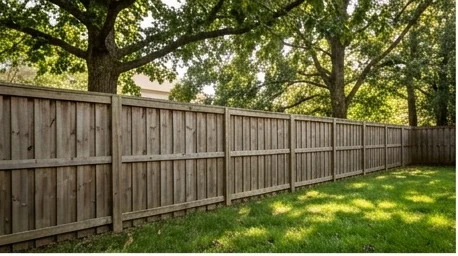
Privacy Fence Installation in Cookeville, TN
Privacy fence installation in Cookeville, TN. Wood and vinyl privacy fencing built for rocky Putnam County ground. Free on-site estimates.
A privacy fence is a different animal from the rest of the fences we build. An open picket or a ranch rail lets weather pass through it. A privacy fence doesn't. It's a solid wall standing six feet in the air, and every gust of wind that hits it transfers straight down into the posts. That one fact drives most of what follows here: how tall to go, which style, wood or vinyl, and what Cookeville's ground and local rules do to the plan. Building on the Plateau instead? See a privacy fence on the Plateau in Crossville.
How tall should a privacy fence be?
Most people asking about privacy want one thing: to not see, or be seen by, whoever is in the next yard over. Six feet does that for a person on level ground. Below that you're building a boundary fence with a solid face, not a privacy screen, and you'll notice the difference the first time someone walks past.
It gets more complicated when the ground isn't level, which in this part of the Plateau is often. If your neighbor's yard sits three feet higher than yours, a six-foot fence on your side is effectively a three-foot fence from their vantage point. Better to catch that during the estimate than after the posts are in. Going taller is possible, but taller panels catch more wind, need heavier framing, and are more likely to hit a height limit in a city rule or an HOA covenant.
Solid board, board-on-board, or shadowbox?
All three read as "privacy fence" to most people, and they behave differently enough to be worth understanding first.
Solid board is boards set edge to edge on one face of the frame. Most screening per board, and the most common thing behind houses around town. The catch is that rails and posts show on one side, so one neighbor gets the finished face and one gets the framing. Decide up front which way it turns.
Board-on-board laps each board over the edge of the next. More lumber for the same run, but it solves a real problem: wood shrinks as it dries, and a solid fence that was tight on install day can show daylight a year later. Lapping the boards hides that shrinkage behind the overlap.
Shadowbox alternates boards on opposite sides of the rails. It looks the same from both yards, which makes it easy on a shared line, and the offset lets air move through instead of pushing against the fence. The tradeoff is honest: at an angle you can see through it. Straight on it screens fine.
| Style | Privacy | Airflow | Appearance | Upkeep |
|---|---|---|---|---|
| Solid board (wood) | Full, straight on and at an angle | Minimal, catches the most wind | One finished side, rails show on the other | Seal or stain on a schedule |
| Board-on-board (wood) | Full, stays full as boards shrink | Minimal | One finished side, more depth to the face | Seal or stain on a schedule |
| Shadowbox (wood) | Full straight on, partial at an angle | Good, air passes between offset boards | Same from both yards | Seal or stain on a schedule |
| Vinyl privacy panel | Full, no shrinkage gaps | Minimal, solid panel face | Same from both yards | Wash it, no staining |
Wood or vinyl for a privacy fence in Cookeville?
Both work here. It usually comes down to how you feel about maintenance and how you want it to look.
Wood gives the traditional look, takes stain, and can be built in any of the three configurations above. The honest downside is that Cookeville summers are hot and humid, and humidity is hard on wood that isn't treated and sealed. Untreated lumber on a privacy fence is a bad bet here. Pressure-treated stock, kept sealed or stained, lasts a lot longer. Our wood fencing page covers the material in more depth.
Vinyl privacy panels don't absorb moisture, so the wet-dry cycling that opens gaps in wood isn't a factor, and they look the same from both sides without paying for board-on-board. They don't take stain either, so the color you buy is the color you keep, and cold makes PVC stiffer and more impact-sensitive. More on that on the vinyl fencing page. Either way, a solid panel is a sail. The fence lives or dies on how the posts are set, not on the panel.
Why post depth matters more on a privacy fence
Cookeville sits on the Eastern Highland Rim, just west of the Cumberland Escarpment, and most of the ground here falls under the Bodine-Baxter-Mountview soil association: rocky, cherty subsoil that's harder to dig than the softer soils west of here. On an open fence that's an annoyance. On a privacy fence it's central, because privacy fences need the deepest, strongest posts, and this is the ground that fights you on getting them.
In practice the post plan here isn't a formality. Spacing tightens where a run is exposed to open wind, holes go deeper than they would on a picket, and rock gets dealt with rather than worked around. A post that stopped short of proper depth because it hit chert is the post that leans in three years. More on that in our guide to setting fence posts in Putnam County's rocky soil.
What happens on a sloped or uneven lot?
Very little ground around here is flat, and a privacy fence shows every inch of it. On a slope you're picking between two approaches, and they look different enough that you should see them before deciding.
- Stepped. Each panel stays level and the fence descends like a staircase. The top line is crisp and horizontal, but at the low end of each panel you get a triangular gap between the fence and the ground. On a steep grade those gaps get big enough to matter, especially if the reason you're fencing is a dog.
- Racked. The panel is built so the boards stay vertical while the rails follow the slope. The fence hugs the ground with no gaps, and the top line runs parallel to the grade instead of level. Wood built on site racks readily. Preassembled vinyl panels have a limit before you need another approach.
One more factor specific to privacy fences: a solid panel is also a dam. Water running downhill hits it. Where a fence line crosses a drainage path, the plan has to account for that, or you get erosion under the fence and a gap you didn't design.
What about the gates?
Gates are where privacy fences fail first, and it isn't close. A gate is the only part of the run that moves, and here it's a heavy solid panel hanging off a hinge post that also carries wind load. That post has to be set for a job the line posts never do.
Decide the width early. If a mower, a trailer, or a truck ever needs into the backyard, measure the widest thing that will go through before we frame the opening. On a wide opening, a double gate or a heavier frame beats one very wide leaf, because a single wide gate on a solid panel sags over time no matter how well it's built. Our gate installation and repair page covers hardware and swing in more detail.
Permits, HOA rules, and historic districts in Cookeville
Height and material are the two things most often restricted, which puts privacy fences right in the middle of it. A six-foot solid fence is the type most likely to run into a rule, so do this homework before the material shows up.
Plenty of Cookeville subdivisions have HOA guidelines on fence height, material, or placement relative to the property line. Brookhaven, Stonebridge, Greystone, Quail Hollow, Carrington Estates, Copperfield, Cypress Creek, Laurel Hill, Magnolia Creek, Saint James, Southern Woods, and White Plains are all names on the city's subdivision map, and we won't guess at any one's rules. Pull your own covenants, or ask your HOA directly.
If your home is in one of Cookeville's historic zoning districts, which include North Dixie Avenue, East Broad and Freeze Street, Cream City, and East 8th Street, check with the City of Cookeville Planning Department about anything additional. Cookeville has also held a Class 9 FEMA Community Rating System rating since 2014 and publishes a Sinkhole/Floodplain Report, so if your lot touches a floodplain or a known sinkhole area, that's worth knowing before we lay out a post line. Our Upper Cumberland fence permit guide walks through the process across the region.
Common questions about privacy fences in Cookeville
Which side of a privacy fence faces my neighbor?
On solid board or board-on-board, one side shows the finished boards and the other shows rails and posts. Nothing forces it one way, and neighbors sometimes have an opinion. If you'd rather skip that conversation, shadowbox and vinyl privacy panels look the same from both yards.
Will a privacy fence blow down in a storm?
A properly built one shouldn't. Wind is the main structural load on a solid fence, and it's carried by post depth, diameter, spacing, and how the posts are set, not by the panel. Fences that come down in wind almost always have a post problem, not a panel problem. If a section of yours has already leaned or dropped, fence repair is often the right call before a full replacement.
Can I get a privacy fence that doesn't need staining?
Vinyl privacy panels get washed, not stained or painted. That's the main reason people pick them over wood in a humid climate. The tradeoff is that the color is fixed and PVC is more brittle in cold. Wood gives more options in style and finish but expects upkeep in return.
How long does a privacy fence take to install?
It depends on the length of the run, the number of gates, how much rock we hit, and how much grade the lot has. We'd rather look at the property than guess over the phone. We do privacy fence work across the Upper Cumberland, including Crossville Fence Repair Crossville Fence Repair McMinnville and McMinnville, and it varies job to job.
Get a privacy fence estimate in Cookeville
If you're ready to talk through a privacy fence for your Cookeville property, we'll walk the line with you, look at the grade and the ground, and tell you what we'd recommend and why. Call or text (931) 651-8856, or send us a message to set up a free on-site estimate. For everything else we do around town, see our Cookeville fence installation page.
Request a Free Estimate
Fill this out and we'll get back to you, or call or text (931) 651-8856.