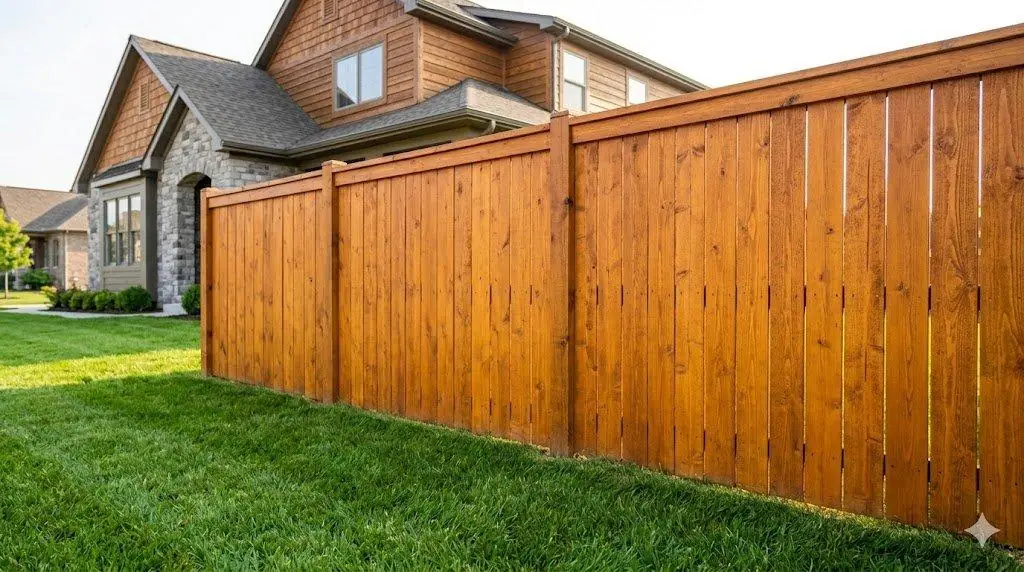
Privacy Fence Installation in Crossville, TN
Wood and vinyl privacy fencing for Crossville, Fairfield Glade, and Cumberland County, planned for Plateau conditions.
A privacy fence in Crossville has a harder job than the same fence built west of here. You're on the Cumberland Plateau at the region's highest average elevation, snow totals run 10 to 13 inches a year against about 7 in Cookeville, and under the topsoil is Pennsylvanian sandstone caprock instead of Highland Rim chert. Add how many Cumberland County neighborhoods are association-governed and you get a project with more moving parts than most homeowners expect.
What Plateau winter does to a tall solid fence
We install wood and vinyl privacy fencing in Crossville, Fairfield Glade, and across Cumberland County. What follows is how we plan one for Plateau conditions, because that is where these jobs go wrong.
A privacy fence is a continuous vertical wall with nothing for air to pass through. Wind that would slip between pickets pushes against this instead, and up on the Plateau it crosses more open ground. Then snow drifts against the low side and sits there, adding weight along the bottom rail through the coldest stretch of the year. Neither one breaks a well-built fence. Both will find the weak point in a badly built one. What decides which you have is whether the posts were set for Plateau conditions or set the way they'd be set in a milder county.
Freeze-thaw is the second winter factor. Cumberland County cycles through freeze and thaw more often than the counties below the escarpment, and each cycle expands the moisture in the soil around a post and then releases it. A post set below the frost line rides that out. A shallow post gets worked a little each season until the run visibly bows. Our cold-weather installation guide for the Plateau covers what changes once temperatures drop.
Sandstone caprock and why post depth isn't negotiable here
Sandstone tends to come in beds and slabs rather than scattered fragments. A hole can go easily for most of its depth and then hit something solid and flat that won't yield. At that point the options are to break through the slab, shift the post along the line, or change the setting method for that hole. Calling the hole deep enough and pouring concrete is how a post ends up shallow.
A fence line leaves room to move, since shifting a post a foot to dodge a slab changes the spacing slightly and nothing else. A gate opening leaves none. The hinge post and latch post have to land where the opening is, so rock under either one gets dealt with rather than avoided. Post depth decides whether a privacy fence stays plumb, and the margin is thinner here because the wind load is higher. Our page on how deep fence posts should be set covers hole diameter and concrete practice.
Fairfield Glade, Lake Tansi, and getting the answer in writing
Cumberland County has an unusual concentration of planned communities, and that changes how a fence project starts. Fairfield Glade is a gated golf and lake community governed by the Fairfield Glade Community Club POA. Fences there require ACC approval in advance, meaning before installation, and above-ground electric fencing is prohibited. Details are on our Fairfield Glade fence approval page.
Lake Tansi Village and the other association-governed neighborhoods around the county may have requirements of their own, and we won't guess at what they say. Pull your covenants or contact your association office, ask about height, material, placement relative to the property line, and whether approval is needed before work starts, then keep the written response.
Permitting runs on a separate track with two possible authorities. Outside Crossville city limits it's Cumberland County Building Codes and Inspection, which has handled code enforcement countywide since January 2024. Inside city limits it's City of Crossville Codes Enforcement. Clearing an association doesn't clear a permit, and in Fairfield Glade you may be dealing with both. Our regional permit overview covers the counties we serve.
Picking a height and a style that hold up here
Height is the thing most often restricted by a code or a covenant, so we won't attach a number to any rule. We can talk about how it behaves. A privacy fence blocks a sightline, and whether a given height does that depends on where the people are standing. On level ground the geometry is simple. The moment either yard sits higher than the other it stops being simple. Much of the Plateau top around Crossville is broad and level, which is why so many lots up there sit flat, but individual yards still fall away toward a drainage or a tree line. A fence that fully screens your patio may screen very little from a neighbor's deck eight feet uphill. Catch that during the estimate walk. Every inch of added height also adds surface for the wind to push on, which means heavier framing, tighter post spacing, and deeper holes.
Style is the other half. Three configurations read as privacy fencing from the street.
Solid board is the configuration most exposed to what Crossville weather does. It presents the largest unbroken face to the wind, and it is the style where seasonal gapping shows worst, because a run that was tight on install day can open up as the boards dry and the freeze and thaw cycle works at them. It gives the most screening per board and the most familiar look, with rails and posts showing on the back side, so one yard gets the finished face.
Board-on-board is the answer to that gapping problem, and it is the configuration we point to most often for a solid fence that still looks solid after a few Crossville winters. Overlapping the boards keeps the screening intact as they dry and move, which costs more lumber for the same run. Our board-on-board and shadowbox page covers how the two are built.
Shadowbox earns its place on an exposed lot, because the offset construction lets wind pass through the fence rather than load it. On the open ground up on the Plateau that matters more than it does down on the Rim. It also reads the same from both yards, which makes it straightforward on a line shared with a neighbor. The tradeoff is that at an angle you can see through the gaps. Straight on it screens.
Wood or vinyl for privacy fencing in Crossville
| Factor | Wood | Vinyl |
|---|---|---|
| Freeze-thaw response | Absorbs moisture, swells and shrinks each cycle | Doesn't absorb moisture, no seasonal gapping |
| Cold-weather toughness | Stays workable in cold, takes an impact without shattering | PVC stiffens in cold and is more impact-sensitive |
| Snow and wind load | Carried by framing and posts, repairable board by board | Carried by posts and rails, panels replaced as units |
| Look from both sides | One finished face unless you choose shadowbox or board-on-board | Same from both yards |
| Upkeep | Seal or stain on a schedule | Wash it, no staining |
| Following a slope | Built on site, racks to the grade readily | Preassembled panels have a racking limit |
Both materials work in Cumberland County. Wood gives you every style above, takes stain, and follows whatever the ground does. Pressure-treated stock kept sealed handles the freeze-thaw cycle, and our cedar and pressure-treated comparison covers how the two age. Untreated lumber up on the mountain is a short-term fence. Our wood fence page covers species and treatment.
Vinyl sidesteps moisture entirely, which removes the seasonal gapping problem, and it looks the same from both yards without paying for board-on-board. There is a cold-weather tradeoff. PVC stiffens as temperatures drop, and Crossville sees more genuinely cold days than the counties below the escarpment, so a panel taking a falling limb in January behaves differently than in July. More on our vinyl fencing page. With either material, how the posts are set decides how the fence holds up.
Gates and slope, the two places a privacy fence gives you trouble
A gate is the only part of a privacy fence that moves, and here it's a heavy solid leaf. The hinge post takes static weight, swinging load, and its share of wind, and has to be set for all three. Measure the widest thing that will ever need through before the opening gets framed, counting mowers and trailers. On a wide opening a double gate usually beats one long leaf, because a single wide solid gate sags eventually regardless of build quality. For a powered entrance, see our automatic gate page for Crossville.
Stepped construction keeps each panel level and drops the run like a staircase, giving a crisp horizontal top line and a triangular gap under the low corner of every panel. On steep grade those gaps get large enough to matter, especially if you're fencing for a dog. Racked construction keeps the boards vertical while the rails follow the grade, so the fence hugs the ground and the top line runs parallel to the slope. Site-built wood racks well. Preassembled vinyl hits a limit. Our page on building fence on sloped ground shows how the approaches differ.
Solid panels on a grade also act as a dam. Where a fence line crosses a drainage path, either that gets planned for or the water finds its own way under the boards. Our page on fence lines, drainage, and erosion covers how to handle it.
Getting an estimate for a privacy fence in Crossville
Every question on this page depends on your specific lot. Where the rock sits, how much fall the ground has, which way the wind crosses, where the gate goes, and what your association requires in writing. That's an on-site conversation.
Estimates are free and on site, we're licensed and insured, and we're locally owned. Brian will walk the line with you, talk through height, style, and material against what the ground and the weather up there will do to it, and put the plan in writing. We serve Crossville, Fairfield Glade, Lake Tansi, Monterey, Cookeville, Sparta, and Livingston. Call (931) 651-8856 or send us the details of your project.
Common questions about privacy fencing in Crossville
Do I need approval before installing a privacy fence in Fairfield Glade?
Yes. Fences in Fairfield Glade require Architectural Control Committee approval in advance, and above-ground electric fencing is not permitted there at all. Get that approval before ordering material, since a privacy fence is bought in a specific height and style.
Is Crossville really that different from Cookeville for fence work?
Yes, and elevation is why. Crossville and the rest of Cumberland County sit on the Cumberland Plateau. Cookeville sits on the Eastern Highland Rim at about 1,140 feet, below the escarpment. Crossville gets roughly 10 to 13 inches of snow a year, runs colder, and has sandstone under it instead of chert. Compare against our Cookeville privacy fence page to see how the same project reads off the Plateau.
Will snow damage a wood privacy fence?
Drifted snow against a solid panel adds weight along the bottom of the fence and holds moisture against the boards longer than a Highland Rim winter would. Sealed pressure-treated lumber handles that. The bigger risk is a post that wasn't set deep enough, since freeze-thaw works on it all winter while the snow load pushes.
Can an existing fence be fixed instead of replaced?
Often, depending on what failed. Leaning posts, sagging gates, and individual damaged boards are usually repairable without redoing the run. Widespread rot or a line where most posts have shifted is another matter. See our Crossville fence repair page, or if you're starting from scratch, the Crossville fence installation page covers the full range of styles we build.