Installing Fence on Sloped Terrain: What to Know Before You Build
Installing Fence on Sloped Terrain: What to Know Before You Build - a guide from Cookeville Fence Co., serving the Upper Cumberland region of Tennessee.
A lot of properties in the Upper Cumberland region aren't flat. Rolling pasture, plateau edges, ridge lines, lake lots that drop toward the water. If your yard has any real grade to it, a fence contractor needs a plan for the slope before the first post goes in the ground. Here's how sloped installations work, and what to expect if your property isn't level.
Stepped vs. Racked: The Two Basic Approaches
| Consideration | Stepped | Racked |
|---|---|---|
| How panels sit | Each panel stays level and steps down the slope like stair treads | Each panel angles to follow the contour, rails parallel to the ground |
| Gaps underneath | Triangular gap under each panel that grows as the grade steepens | Continuous line with no stair-step gaps |
| Suited materials | Vinyl and most pre-fabricated rigid panel systems | Wood, chain link, and ornamental iron systems built for slope adjustment |
| Containment | Bottom gaps can let animals or small children through | Consistent bottom line, better for containment |
| Drainage | Gaps often double as water relief, letting runoff pass through | May need extra grading or a ground-level gap so water does not back up |
There are two standard ways to run a fence up or down a hill.
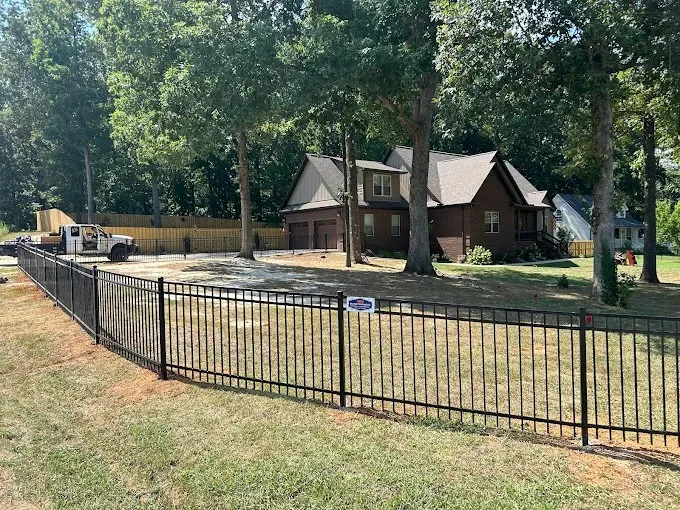
Stepped (or "stair-step") installation keeps each fence panel level, but steps each section down the slope like stair treads. This leaves a triangular gap under each panel that grows bigger as the grade gets steeper. Stepping is common with vinyl and most pre-fabricated panel systems, because the panels themselves are rigid and can't bend to follow the ground.
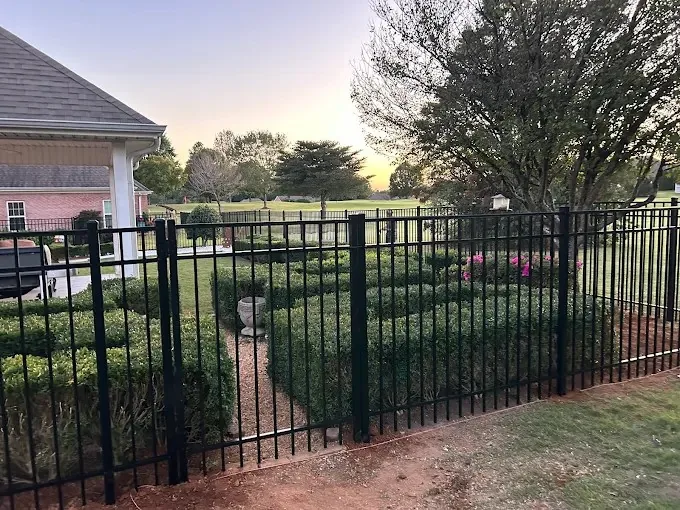
Racked (or "raked") installation angles each panel to follow the contour of the slope, so the top and bottom rails run parallel to the ground instead of level to the horizon. This gives a continuous line with no stair-step gaps underneath. Racking works well with materials that flex or can be custom-cut on site, like wood, chain link, and some ornamental iron systems built for slope adjustment.
Which approach makes sense depends on the material, how steep the grade is, and whether keeping animals or small children contained is a priority. Gaps under a stepped fence can be a real problem for that.
Material Matters More on a Slope
Not every fence material handles grade changes the same way.
- Wood fencing is the most flexible option for sloped ground. Crews can cut and fit individual boards and rails on site, so a wood fence can be racked smoothly along almost any grade, or stepped if that look is preferred. See our wood fencing page for more on styles and options.
- Vinyl fencing usually comes in pre-molded panel sections, which makes true racking hard. Most vinyl installers step the panels instead. Some manufacturers make slope-adjustable rail brackets that allow a limited amount of racking, but the range isn't unlimited. Check our vinyl fencing page if you're weighing vinyl against other materials for a sloped lot.
- Chain link racks fairly easily since the fabric itself is flexible, even though the top rail typically follows a stepped or gently sloped line.
- Ornamental iron can sometimes be custom-fabricated to rake with the slope, but that adds complexity and needs to be planned before panels are ordered.
- Split rail fencing is naturally suited to rolling or sloped pasture and farm ground, since the rails are simple and easy to adjust at each post. See our split rail farm fence page if you're fencing pasture or acreage with varied terrain.
Post Depth and Spacing Change on a Grade
On sloped ground, posts often need closer spacing and careful depth-setting to keep the fence line stable, especially where erosion, runoff, or loose fill soil is a factor. A post set at the low side of a step can end up shorter above ground than one on flat terrain, which cuts into how much strength it has to resist wind or pressure. Good sloped installation accounts for this instead of just repeating a flat-ground post pattern down the hill.
Drainage Is Part of the Job
Water runs downhill. A fence line that crosses or follows a slope can end up acting like a small dam if nobody plans for drainage. Gaps under a stepped fence often double as water relief, letting runoff pass through instead of pooling against the fence. On a racked fence, or in low spots where water tends to collect, you may need extra grading or a small gap at ground level to keep water from backing up against posts and panels during heavy rain. Bring this up with whoever is doing your install, especially if your property has any history of standing water or erosion.
Gates on a Slope
Gates need a level, or at least consistent, swing path to open and close properly. That makes them one of the trickier parts of a sloped installation. A gate installed at a transition point on a hill may need a leveled pad, a modified hinge setup, or a slightly different post placement than the rest of the fence line to keep it from dragging or swinging open on its own. If you're planning a gate anywhere along a sloped section, flag that early so it gets planned for instead of fixed after the fact. More on this on our gate installation and repair page.
Why This Is Worth Getting Right the First Time
A fence that's stepped or racked wrong for the terrain tends to show problems over time. Gaps let animals or water through where they shouldn't. Posts lean or loosen because nobody set them with the grade in mind. Or the fence line just looks off because the panels don't follow the land the way they should. Sloped terrain isn't a reason to avoid a certain material, but it is a reason to make sure whoever installs your fence has actually accounted for the grade before quoting the job.
If you're not sure how your yard's slope will affect material choice, post spacing, or cost, that's a normal question to bring to an estimate. See our fence cost page for a general look at what factors into pricing, or browse our fence installation services page for more on how we approach a new install. For an existing fence that's already showing signs of slope-related stress, our fence repair page covers common fixes.
Every sloped property is a little different. If you'd like someone to walk your specific grade and talk through stepped vs. racked options for your material of choice, contact us or call (931) 651-8856 for a free estimate.
Request a Free Estimate
Fill this out and we'll get back to you, or call or text (931) 651-8856.