Vinyl Fence Installation in Cookeville, TN
Vinyl fence installation in Cookeville, TN. Privacy, picket, and ranch rail PVC fencing set for rocky Putnam County ground. Free on-site estimates.
Vinyl fencing is PVC, a rigid plastic formulated for outdoor use. Posts and rails are hollow, sometimes with an aluminum stiffener inside a gate frame or a taller panel. It does not rot, does not rust, and never needs stain, sealer, or paint. That last point is the whole reason people call about it. Someone who has spent a few Saturdays staining a wood fence in a Cookeville summer tends to arrive at vinyl on their own. If you are after a six-foot solid screen, our privacy fence guide for Cookeville covers height and slope.
You pay more up front and stop paying after that
A wood fence is cheaper to put in the ground and then bills you for the rest of its life in stain, sealer, weekends, and eventually replacement boards. Vinyl takes that money at the front. Whether the math works depends on how long you intend to own the property. Somebody selling in three years is buying a look. Somebody there in twenty is buying out of a chore. Our Tennessee fence cost guide covers the rest.
| Vinyl | Wood | |
|---|---|---|
| Up-front cost | Higher for a comparable run | Lower on install day |
| Routine upkeep | Wash it down, nothing else | Stain or seal on a schedule |
| Reaction to humidity | Absorbs no moisture, so no swelling or warping | Swells, shrinks, and can cup or warp over time |
| Reaction to hard cold | Stiffens, more likely to crack on impact | Largely unaffected by cold itself |
| Color | Fixed at purchase, cannot be changed later | Takes stain or paint, can be recolored |
How vinyl fencing in Cookeville handles humidity and freeze-thaw
Upper Cumberland summers are hot and wet, and that is what ages a wood fence. Boards take on moisture, give it back, and move a little every time, which over enough seasons gives you cupping, splitting, and gaps that were not there on install day, a cycle we cover under summer humidity and wood fence warping. Vinyl sits it out entirely. It takes on no water, so there is nothing to rot at the ground line where wood posts usually fail first.
Winter is the honest caveat. PVC becomes more brittle as it gets colder. Around Cookeville that matters a handful of times a year, on the mornings that drop into the teens, and it shows up as impact sensitivity rather than anything gradual. A branch in an ice storm, a basketball, a mower deck clipping a picket, any of these are likelier to crack a cold panel than a warm one. A cracked panel in February is normal and not a defect. Vinyl also expands and contracts more than wood or metal, so good installation leaves room for that movement at the connections instead of pinning everything tight.
Wall thickness is why cheap vinyl fails
Two vinyl fences can look identical the week they go up and be nowhere near the same product. Vinyl is hollow, so how much PVC sits in the wall of a rail or post decides how it holds up. A thicker wall resists sagging across a span and takes an impact without splitting. A thin one does neither, and announces itself in year three with a droopy top rail. Chemistry matters as much as thickness. Exterior-grade PVC carries titanium dioxide for UV resistance and impact modifiers to keep it from going glassy in cold. Cheap vinyl skimps on both. A quote specifying wall thickness and grade is telling you something, and sorting out claims like that is most of choosing a fence company.
How panels attach, and why the posts still decide everything
Vinyl goes together differently from wood. Rails slot into routed openings punched through the posts, and pickets slide into channels in the rails. The post holds the rail rather than a fastener holding it, so there is almost no visible hardware on a finished run.
Because everything interlocks, the run is only as good as the posts, and vinyl posts are hollow. A wood post has stiffness of its own. A vinyl post gets its strength from the concrete footing and from being set to depth. One post digs easily, the next stops short on stone, and post depth is what gets gotten wrong most often here. See setting posts in Putnam County's rocky soil.
Corner and gate posts carry the most load and most need full depth with concrete. A gate is a lever and it works its post every time somebody swings it, which is why a vinyl gate frame usually gets an aluminum insert. Hollow PVC alone racks out of square. For wider openings, see gate installation and repair.
Which vinyl style fits what you are trying to do
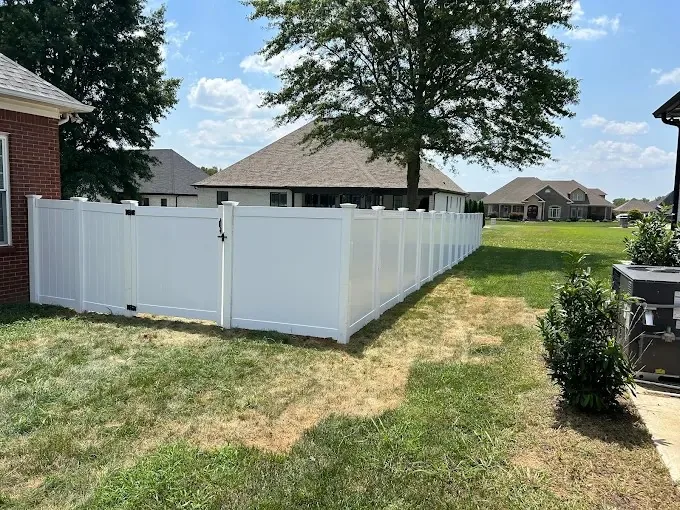
- Solid privacy panels. Tongue-and-groove boards, usually six feet, identical from both sides so there is no finished-side conversation with a neighbor.
- Semi-privacy and lattice-top. A solid lower section with an open lattice top. Screens a patio while letting air through, and takes wind better than a solid panel.
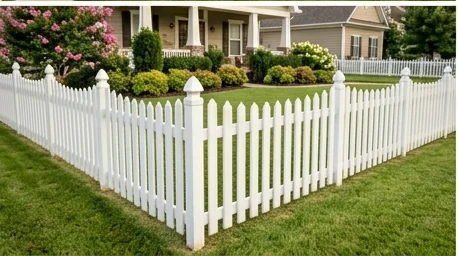
- Picket. Front yards and garden enclosures, three to four feet, without repainting every few seasons.
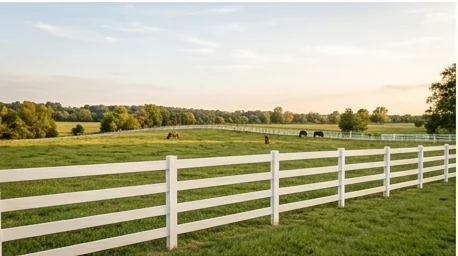
- Ranch rail. Two-rail or three-rail for marking a boundary or a driveway. For containing working livestock, wood or woven wire remains the right answer.
- Pool enclosure. Splash and pool chemicals do nothing to PVC. Pool barriers carry their own code rules on height and latching.
Color choice is narrower than people expect and it is permanent. White and the tan and almond family cover most of what gets installed, with gray, khaki, and woodgrain finishes from some manufacturers at a step up. Vinyl does not take stain or paint in any way that lasts, so the color you order is the color you own. If a finish you can revisit matters to you, look at wood fencing first.
What happens when a vinyl fence gets damaged
On a wood fence you pull one bad board, cut a new one, and stain it to blend. On vinyl there is no blending. A split panel comes out whole. The swap is clean, though. Because everything slots together, a damaged section lifts out once the rail is freed and the replacement drops into the same openings. No demolition and no re-digging.
The catch is matching. A panel installed a decade ago has faded some, and a new white one beside it will read brighter for a while. Manufacturers also discontinue profiles, which argues for buying a line that will still exist in ten years. A leaning post is a separate problem pointing back to the footing, and fence repair is often the cheaper call before replacing a run.
Vinyl fence installation in Cookeville and the towns around it
We install vinyl fencing in Cookeville and out through Algood, Baxter, Monterey, Sparta, Livingston, Crossville, and McMinnville. The ground changes across that area, which changes the post plan more than anything else. Cookeville and Algood sit on the Eastern Highland Rim with cherty limestone under them. Monterey up the mountain, and Crossville over in Cumberland County, sit on the Cumberland Plateau proper at higher elevation, which means colder winters and more ice, and that moves the cold-brittleness question from a footnote to something worth raising on the estimate.
Before anything gets ordered, check what your subdivision and your local office allow. Plenty of neighborhoods have covenants on fence height, material, or color, and vinyl comes in a short enough color list that a restriction can rule out what you had in mind. Inside Cookeville city limits, permitting goes through the City of Cookeville Planning Department. In unincorporated Putnam County it is the Putnam County Codes and Planning Department under the 2018 ICC codes. Pull your own covenants or ask your HOA, and see fence permits across the Upper Cumberland.
Every estimate is free and done on site, because vinyl fencing in Cookeville turns on details you cannot get over the phone. Where the rock is, how the grade runs, whether a gate needs to clear a mower. You get a written quote covering materials, gate hardware, and how the posts get set. Call or text (931) 651-8856 or send us a message. For everything else, see Cookeville fence installation.
Common questions about vinyl fencing
Does vinyl fence turn yellow or get brittle in the sun?
Good vinyl resists both and cheap vinyl does neither well. Some gradual fading is normal on any color over enough years. Rapid yellowing in the first few seasons points at a thin, under-formulated product rather than at vinyl itself.
Can a vinyl fence crack in cold weather?
Yes, and it is the material's real weakness. PVC stiffens as temperatures drop, so a panel is likelier to crack from an impact on a fifteen-degree morning than on a summer afternoon. It does not crack from cold alone. It cracks when something hits it while cold.
Can vinyl fencing be painted a different color later?
Practically, no. PVC is a poor surface for paint to bond to, and painted vinyl tends to peel and chalk within a couple of seasons. Choose the color at purchase and plan on living with it.
Does vinyl fencing work on a rocky or sloped lot?
It works, with a caveat on each. Rock affects vinyl exactly as it affects every other material, because the post still has to reach depth. On slope, preassembled vinyl panels rack to follow a grade only so far before you step them down instead, which leaves a level top line and a triangular gap under each panel. Wood built board by board on site follows a steep grade more readily.
Putting a fence around a pool? Pool fencing in Cookeville covers what the barrier has to meet.
Request a Free Estimate
Fill this out and we'll get back to you, or call or text (931) 651-8856.
Vinyl Fence Styles We Install