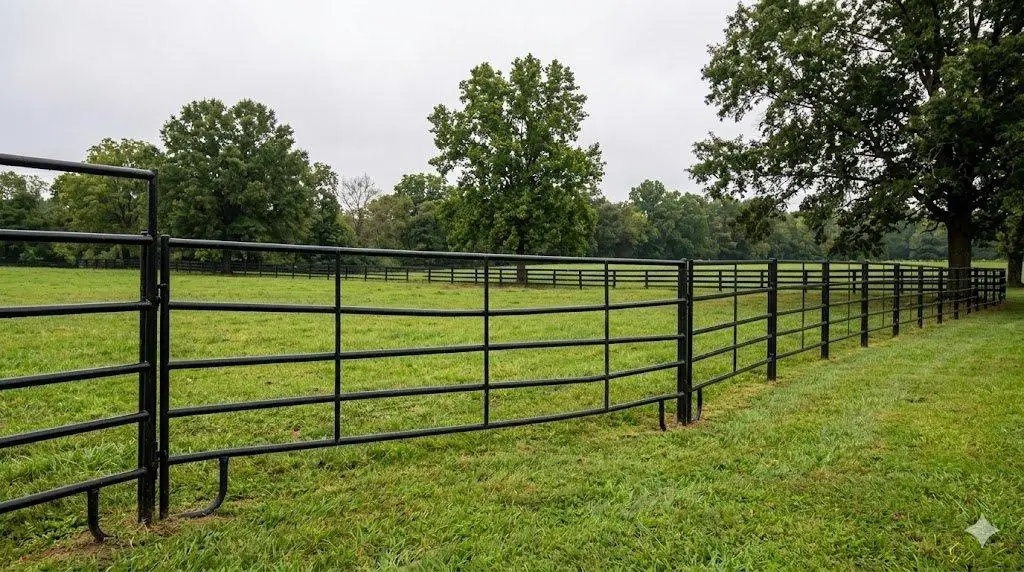
Fence Repair in Cookeville, TN
Fence repair in Cookeville and Putnam County, TN. Leaning posts, storm damage, rotted boards, sagging gates. Free on-site estimates.
Most fence repair calls in Cookeville start the same way. Something moved. A post that stood straight for years is now tipped toward the neighbor's yard, a gate that used to latch with one hand needs a knee and a shoulder, or wind took out three panels and left the rest standing. The fence didn't fail all at once. It failed at one point, and that point has a cause worth finding before anybody pulls a board off.
We repair fences across Cookeville and the rest of Putnam County. This page is about fixing what's already there: what tends to go wrong here, how the ground complicates a post reset, and how to tell an honest repair from a fence that's telling you it's done. Starting from scratch instead? Our Cookeville fence installation page covers that side of the work.
Why do fences fail the way they do around Cookeville?
Cookeville sits on the Eastern Highland Rim, just west of the Cumberland Escarpment, and the weather here works on a fence in a specific order. Hot humid summers keep wood damp at the soil line and encourage rot right where you can't see it. Cold winters and periodic ice load the top rail, coat every picket, and turn a marginal post into a leaning one. Between those seasons, the ground expands and contracts, working posts loose a fraction at a time.
Then there's what's under the fence. Much of the Cookeville area sits on the Bodine-Baxter-Mountview soil association, with a rocky, cherty subsoil that's harder to dig than the softer soils of the Nashville Basin. When the original holes were that hard to dig, a post that was set shallow, or backfilled with loose rock instead of a solid set, will usually be the first one to lean. That is worth checking before you assume the whole line is failing.
Karst terrain matters here too. Cookeville has held a Class 9 rating in FEMA's Community Rating System since 2014 and publishes a Sinkhole/Floodplain Report, which reflects how much surface water and underground drainage interact around here. Where a fence crosses ground that collects or moves water after a heavy rain, that section shows problems first.
What can actually be repaired instead of replaced?
Plenty. A fence is a system of separate parts, and parts fail at different rates. Common repairs here:
- Leaning or heaving posts. Reset, replaced, or reinforced depending on what the post itself is doing and what the ground under it is doing.
- Rotted or warped boards. Individual pickets and rails swapped out where the surrounding fence is still sound.
- Storm and wind damage. Sections knocked down or pushed out of line, often with a couple of posts to address behind them.
- Sagging gates. Usually a hinge, a post, or a frame that's racked out of square, and sometimes all three.
- Rusted or failed hardware. Hinges, latches, brackets, and tension bands that gave out before the fence did.
Gates get repaired more than anything else on a fence. They move thousands of times a year while the rest of it just stands there. Our gate repair and installation work covers driveway gates and walk gates both.
Should I repair this fence or replace it?
Neither answer is automatically right, and any contractor who calls it from the driveway without walking the line is guessing. What we're looking for is whether the problem is local or general. One post down in an ice storm is an event. Five posts leaning in five directions is a pattern, and patterns rarely stop on their own. Here's roughly how the signals sort out:
| What you're seeing | Points toward repair | Points toward replacement |
|---|---|---|
| Extent of damage | Confined to one section or a few posts | Spread along most of the fence line |
| Post condition | Posts sound, one or two loose in the ground | Soft or crumbling at the soil line in multiple places |
| Cause | A one-time event: storm, vehicle, falling limb | Age and cumulative weather across the whole fence |
| Boards and panels | Some warped or split, most still solid | Widespread warping, splitting, or gray punky wood |
| Repair history | First real problem the fence has had | You've fixed something on it every year lately |
| Appearance | New material will weather in acceptably | Fence is too far gone for a patch to look right |
| What you want from it | Same fence, same height, same layout | You've been wanting a different style or more privacy anyway |
There's a middle path people forget: partial replacement. Replacing the one run that took the worst of the weather while repairing the rest is often the sensible answer on a larger property, especially rural Putnam County parcels where one side faces open ground and the other is sheltered.
If replacement is the right call, our Tennessee fence cost guide explains what drives the number, and we'll walk you through it in person rather than over the phone.
Will the repair match the rest of my fence?
Wood is the hardest case. A fence that's been through several Cookeville summers has gone gray-brown, and nothing off the rack looks like that. If a uniform appearance matters, staining the whole fence after the repair does more than hunting matching boards.
Vinyl and ornamental iron hold color better, but if the original product line has been discontinued, panel profiles and rail dimensions may not line up exactly. We'll tell you what we can find and what the closest option looks like before the work starts, not after. Our wood fencing and vinyl fencing pages go deeper into how each one ages.
Why is resetting a post harder than digging a new one?
Here's where Cookeville's ground makes repair different from installation. On a new fence, we pick where the holes go. On a repair, the hole is already there, and so is whatever's in it.
In the cherty subsoil common around here, an old hole is usually full of broken concrete, loose rock, and the snapped-off bottom of the original post. Clearing that out without widening the hole so much that the new post has nothing solid to bear against takes longer than drilling fresh ground a few feet over. The fence on both sides is still attached, too, and has to be supported while the post comes out. On chain link fence lines, the fabric tension has to be released and re-set properly or the repair pulls itself crooked within a year.
None of that makes a reset a bad idea. It just means "replace that one post" is rarely as small a job as it sounds, and it's why we look at the ground and not only at the fence.
Do I need a permit to repair a fence in Cookeville?
A like-for-like repair that doesn't change height, material, or footprint isn't the same as installing new fence, but the office that answers that question depends on where you sit. Inside city limits it's the City of Cookeville Planning Department. In unincorporated Putnam County it's the Putnam County Codes and Planning Department, working from the 2018 ICC codes. If a repair grows into replacing a whole fence line, treat it as new and check first. Our Upper Cumberland permit guide covers the surrounding counties.
Two more local notes. Plenty of Cookeville subdivisions carry HOA covenants, and where they do, a repair that changes the look of the fence can fall under them the same way a new fence would. We won't guess at what any particular association requires. Pull your own covenants before you commit to a different picket profile, or ask your HOA directly. If your property sits in one of Cookeville's historic zoning districts, which include North Dixie Avenue, East Broad and Freeze Street, Cream City, and East 8th Street, check with the city planning department about what applies to your address.
What should I do right after storm damage?
- Make it safe first. Look for downed power lines before you go near the fence. If there are any, stay back and call the utility.
- Contain pets and livestock. A gap is an immediate problem regardless of how long the repair takes. Temporary panels or a leash routine beats a lost dog.
- Take photos before you clean up. Wide and close. If you file an insurance claim, pictures of the fence as it fell are worth more than pictures of the pile you stacked.
- Save the fallen material. Don't haul off boards or panels yet. Some of it is reusable, and even the broken pieces help identify the original product.
- Get it looked at. Call us at (931) 651-8856 and we'll come out, walk the line, and tell you what the fence actually needs.
Frequently asked questions about fence repair in Cookeville
Do you repair fences you didn't install?
Yes. Most repair work is on fencing that was already there when the homeowner bought the property, or that somebody else built years ago. We don't need to have installed it to fix it. We do need to see it, because the original construction says a lot about why it's failing.
Can one leaning post be fixed without redoing the whole section?
Often, yes. It depends on whether the post is the problem or a symptom. If it's sound and just worked loose in the ground, resetting it is straightforward. If it's rotted at the soil line or the ground has shifted, the fix goes deeper, and we'd look at the posts on either side while we're there.
Do you handle repairs outside Cookeville?
We work throughout the Upper Cumberland. Our regional fence repair page covers the full picture, and we serve Crossville Fence Repair Crossville Fence Repair McMinnville and McMinnville among other towns nearby.
My neighbor and I share the fence. Who handles the repair?
That's between you and your neighbor, and it's worth settling before work starts. We'll talk to both of you and give the same assessment so nobody's working from different information. What we can't do is decide who pays.
How do I get a repair estimate?
Call or text (931) 651-8856, or reach us through the contact page. Tell us the material, roughly how much is affected, and where in the Cookeville area you are. Estimates are free and done on site, because a repair quote given without seeing the fence isn't worth much to either of us.
Request a Free Estimate
Fill this out and we'll get back to you, or call or text (931) 651-8856.