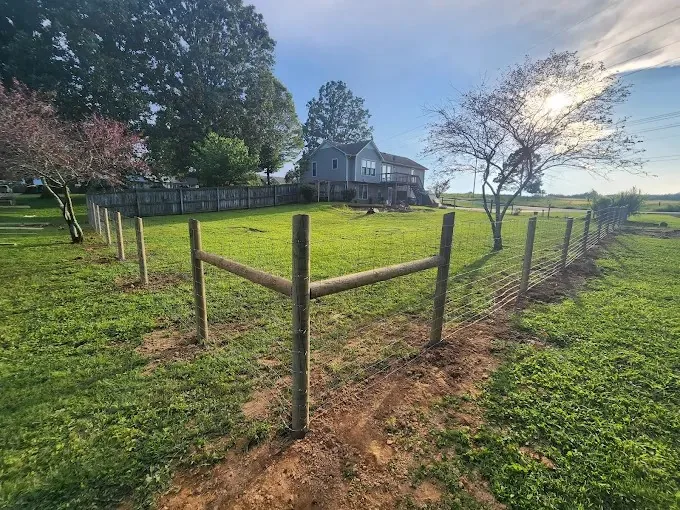
Farm and Cattle Fencing in White and Putnam Counties
Farm and Cattle Fencing in White and Putnam Counties - a guide from Cookeville Fence Co., serving the Upper Cumberland region of Tennessee.
White County and Putnam County sit on opposite sides of a farming line that shapes what kind of fence actually holds up. White County ranks #14 in Tennessee for cattle sales, and 66% of its land is in farms. That puts it firmly in working-cattle-country territory. Putnam County runs the other angle: the surrounding county has a long working history of cattle and horse farming tradition. Both counties need fence that keeps livestock contained through weather, terrain, and years of animals leaning on it. Neither county forgives a fence that was built to look good instead of to hold.
Why Putnam County Ground Fights You on Post Holes
Putnam County straddles the Eastern Highland Rim and, on its eastern edge, the Cumberland Plateau. The soil here is part of the Bodine-Baxter-Mountview association, rocky and cherty subsoil that's a different animal from the deeper, softer ground of the Nashville Basin. Anyone who's tried to hand-dig a post hole in this soil already knows the problem. Chert fragments and shallow bedrock mean posts hit resistance fast, and a contractor who doesn't adjust for it ends up with shallow-set posts that lean or heave within a season or two.
For cattle fencing, that matters because a leaning corner post or line post under tension is a failure point. Once one post goes, the whole line loses tension. Post spacing, hole depth, and setting method all need to account for what's actually in the ground, not just what a spec sheet says. It's also why we install split-rail and farm fencing with real subsurface conditions in mind, not a one-size approach carried over from flatland installs.
Cookeville's Karst and Floodplain Factor
Cookeville also carries a documented FEMA Community Rating System floodplain designation (Class 9 since 2014) and has a published Sinkhole/Floodplain Report. Both reflect the real karst and flood interaction found across this part of the Plateau. For a farm fence, that means low-lying pasture sections can see standing water or drainage shifts, and a fence contractor needs to plan around that in post placement and material choice for the wetter sections of a property.
If you're inside Cookeville city limits, fence permitting runs through the City of Cookeville Planning Department. Outside the city, in unincorporated Putnam County, it's the Putnam County Codes and Planning Department, which works under 2018 ICC codes. Knowing which office applies to your property before you order materials saves a step later.
White County's Farmland Numbers and What They Mean for Fence Layout
White County's 66% farmland share and its #14 ranking in Tennessee cattle sales aren't just statistics. They describe a county where most working land is actually stocked with livestock, not just zoned for it. That density means fence lines tend to run longer, cross more variable terrain, and see more sustained pressure from herds working a perimeter over years, not months.
For cattle, that argues for fencing built for containment first and appearance second. Think consistent line tension, corner and brace assemblies strong enough to anchor long runs, and a layout that accounts for where cattle naturally travel and lean, like gates, water access points, and shade. We build and repair this kind of perimeter fencing through our fence installation services and keep it working through fence repair services when a line takes damage from a fallen limb, a washout, or simple age.
Permitting in White County depends on whether the property sits inside Sparta city limits (City of Sparta Planning & Zoning) or in the unincorporated county (White County Building Inspector).
What This Means for Choosing Materials
Cattle fencing has to survive things ornamental fencing never deals with: sustained rubbing, occasional direct impact, and long runs across uneven pasture. For most working cattle operations in this region, that points toward split-rail and farm-style fencing built for perimeter and cross-fencing rather than curb appeal. Where budget and terrain allow, some producers pair perimeter fencing with lighter interior cross-fencing to rotate grazing across pasture sections.
Property owners weighing fence types against realistic costs for their acreage can start with our Tennessee fence cost guide, which covers how material choice and terrain affect a project's scope.
Two Counties, One Approach
Whether the job is a new perimeter fence on a White County cattle operation or a repair on a Putnam County property fighting rocky subsoil, the fundamentals stay the same. Know the ground, know the permitting authority, and build to contain livestock through years of real use, not just the first season. If you're planning fence work on farm or pasture land in either county, we're glad to walk the property and talk through what the terrain and herd size actually call for. Reach out to get started, or call us directly at (931) 651-8856.
Running horses instead of or alongside cattle changes the fence spec. See our horse fencing page for what to use instead of barbed wire.
Request a Free Estimate
Fill this out and we'll get back to you, or call or text (931) 651-8856.