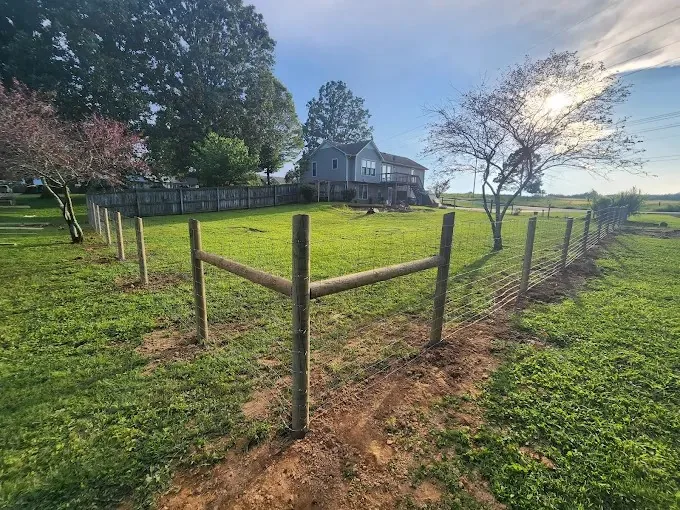
Fence Repair in McMinnville, TN
Fence repair in McMinnville and Warren County, TN. Residential, farm, and nursery fence repair. Free on-site estimates.
Fences fail in McMinnville the same way they fail everywhere, but what's behind the fence changes what a repair has to accomplish. Warren County is the Nursery Capital of the World, with more than 400 nursery operations and the top ranking in Tennessee for nursery, greenhouse, floriculture and sod sales. A lot of the fence we get called out to fix around here isn't holding a dog in a backyard. It's protecting growing stock, marking a leased block, or hanging on a gate that a tractor pushes through four times a day.
We handle both. Residential repair in town, and the longer, harder-used fence lines out on growing ground. What follows is how we approach each, and how to tell which repairs are worth making.
What makes nursery and farm fence repair different?
On a residential lot, a broken section is a nuisance. On a nursery block, an open fence line is exposure. Specimen and ornamental trees represent years of growing time, and deer pressure on a gap in the fence can undo a lot of that in a few nights. So the first thing we ask on a nursery call is which sections are actually holding something in or keeping something out, and which are just boundary. That tells us what gets fixed first if the whole line needs work.
The other big difference is gates. A walk gate on a residential fence opens a few times a day and weighs almost nothing. A field gate on a growing operation gets swung open by hand, driven through with a tractor or a loaded trailer, and left standing open in the wind. Hinges wear out faster, latch hardware gets bent, and the gate post itself takes a load the line posts never see. When we look at a sagging farm gate, we're usually looking at the post before we look at the gate.
Long runs also change how damage shows up. On a hundred feet of fence you notice one leaning post. On a quarter mile you don't, until the line has pulled out of true in three places and the tension has moved onto posts that weren't built to carry it. That's why we walk the whole run on agricultural calls rather than just the section somebody pointed at.
What causes most fence damage around Warren County?
McMinnville sits at the foothills of the Cumberland Plateau, in the area locally called "the Barrens." The regional climate does most of the damage: hot humid summers, cold winters, and periodic ice. Each of those hits fencing differently.
- Wind and storms. The most common emergency call. Solid privacy fence acts like a sail, and a gust can lay down a whole run of it. Falling limbs take out individual sections.
- Ice. Weight on top rails and on wire fencing, plus limbs coming down loaded. Ice damage often shows up as a fence that looks fine but has posts working loose.
- Freeze and thaw. Ground movement over a winter lifts posts that weren't set deep enough. This is the source of most "my fence is suddenly crooked" calls in spring.
- Rot. Humid summers plus wood meeting soil. Wood posts almost always fail at the ground line, not at the top, and a post can look solid until you push on it.
- Equipment contact. On growing operations, a lot of damage is simply something being backed into. It's usually localized and usually one of the easiest repairs to make.
Should you repair the fence or replace it?
The question we get most often. There's no clean rule, but there is a useful way to think about it: repair the fence when the problem is the fence's covering, and consider replacement when the problem is the fence's structure. Broken pickets, damaged panels, sagging chain link fabric, bent iron, failed gate hardware. Those are surface problems, and they're worth fixing on an otherwise sound fence.
When posts are the issue, it gets more complicated. One heaved or rotted post is a repair. Six of them scattered across a run means the whole line was set the same way and the rest are on the same schedule. Fixing those one at a time as they fail costs more over a few years than doing the run once. On a nursery operation the calculation adds another factor, which is what a fence failure costs you in stock while you're waiting on the next repair.
We'd rather tell you a section is worth repairing than sell a replacement you don't need. We also aren't going to patch a fence line that's going to fail again next winter and let you find out the hard way. Our region-wide fence repair service page covers how we diagnose damage in more detail.
How do you match a repair to an existing weathered fence?
This matters more than people expect, especially on a residential fence in town where the repair is going to be looked at every day. New wood next to fence that's been out in the sun for eight years does not match, and no stain fixes that on day one. What we can do is choose material and profile that will weather toward the existing fence, put the new sections where they're least conspicuous when there's a choice, and be straight with you about how long it takes to blend.
Vinyl and ornamental iron are easier in one way and harder in another. The color holds, so a matching panel matches. The catch is product lines change, so an exact profile match on an older fence isn't always available. We'll tell you up front if we can't match it rather than installing something close and hoping you don't notice. The same goes for chain link, where mesh gauge and coating can differ noticeably from an older run.
What does the repair visit actually look like?
- Walk the line. Not just the broken part. On long agricultural runs this is the step that finds the problems you'd otherwise be calling about again in six months.
- Find the cause. A leaning post could be rot, could be frost heave, could be tension pulling from a failure fifty feet away. The fix is different in each case.
- Sort by priority. On growing ground, sections that protect stock or contain animals come before boundary sections. On a residential fence, usually gates and anything that isn't secure.
- Give you the assessment. What we'd repair, what we'd replace, what can wait, and why. What we'd replace, what can wait, and why, before any work starts.
- Make the repair. Then we walk it back with you before we leave, so you can see what changed and what we left alone.
What about repairs in the downtown historic district?
The McMinnville Downtown Historic District has been listed on the National Register of Historic Places since 1987. It's a nine-block area with 64 contributing properties built between 1884 and 1937. If your property sits inside it, check with the city before starting fence work, including repairs that change how the fence looks. We haven't found a published fence-specific ordinance for the district, so the safe move is a phone call to the city rather than an assumption either way.
For properties in unincorporated Warren County, the Warren County Building and Environmental Codes Department is the office that handles county permitting. As a general matter, a straightforward repair that doesn't change a fence's height or footprint is a different situation than replacing a whole line, but confirm it for your address rather than taking that as a rule. Our permit guide for the Upper Cumberland goes through this by county.
Do you repair fences outside McMinnville itself?
Yes. We cover Warren County generally, including Rock Island, the unincorporated community out on the Warren and White county line near Rock Island State Park, where the Caney Fork, Collins, and Rocky Rivers come together. River-adjacent and wooded properties out that way see a different mix of problems than in-town fences, with more tree and limb damage and more moisture at the post base.
We work across the region more broadly too, from Cookeville east to Crossville Fence Repair Crossville Fence Repair McMinnville. If you're not sure whether your property is in range, call and ask. If you're weighing a repair against starting over, the McMinnville installation page covers what we build and the materials we work with.
Common questions about fence repair in McMinnville
My fence blew down in a storm. How fast can you get out?
Call us and tell us what's exposed. A downed section on a nursery block with stock behind it or a fence containing livestock gets treated differently than a cosmetic break, and we'll tell you honestly where we can fit you. If it's an animal containment problem, say so when you call.
Can you repair just the gate instead of the whole fence?
Yes, and it's a common call. Sagging gates, worn hinges, latches that no longer line up, and gate posts that have started to lean are all repairable on their own. See our gate installation and repair page for what that work covers.
Can you repair fencing while a nursery block is in production?
Usually. It depends on access and how much room there is to work between rows without damaging stock. Tell us what's planted and how close it comes to the fence line when you call, and we'll plan the approach around it rather than showing up and figuring it out.
Do I have to be there for the estimate?
It helps, especially on larger properties where you know the history of the fence and where the problem spots have been. On long agricultural runs, ten minutes of you pointing at things saves us an hour of guessing. There's no charge for the visit. Call (931) 651-8856 or use our contact page.
Request a Free Estimate
Fill this out and we'll get back to you, or call or text (931) 651-8856.