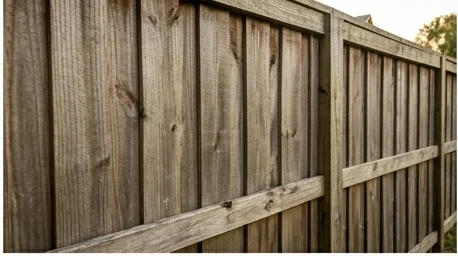
How Summer Humidity Causes Wood Fence Warping (and How to Prevent It)
How Summer Humidity Causes Wood Fence Warping (and How to Prevent It) - a guide from Cookeville Fence Co., serving the Upper Cumberland region of Tennessee.
Wood is a natural material. It never fully stops responding to the air around it. Through the summer months in Tennessee, high humidity pushes moisture into fence boards and posts, and that moisture is what leads to the cupping, bowing, and twisting most homeowners just call "warping." Once you understand why it happens, it's a lot easier to prevent, and a lot easier to tell when a board needs to be replaced versus when it'll settle back down on its own.
Why Wood Moves With the Weather
Wood is hygroscopic. That means it absorbs and releases moisture depending on the humidity around it. When the air is thick with moisture, as it commonly is during Tennessee summers, wood fibers swell. When the weather turns dry again, the same fibers shrink back down. A board that swells and shrinks evenly across its whole surface generally stays flat. The problem is that most fence boards don't dry evenly.
A typical picket or fence board is exposed to the weather on one face and partially shielded on the other, whether by fence structure, mulch, siding, or simple orientation. The exposed face absorbs and releases moisture faster than the back face. That mismatch in expansion and contraction is what pulls a board out of flat and makes it cup or bow. It's the same reason a board that sits closer to the ground, where soil moisture and splashback keep it damp longer, often warps before a board higher up the same fence panel does.
Common Signs of Humidity-Related Warping
- Boards that cup, curling at the edges while the center stays relatively flat
- Pickets that bow outward or inward along their length
- Gaps opening up between boards that used to sit flush
- Fasteners backing out as the wood around them swells and shrinks
- Twisting at the top of a picket where one edge dries faster than the other
Some of this movement is normal and temporary. Wood that swells during a wet stretch and shrinks back during a dry spell isn't necessarily damaged. Warping becomes a lasting problem when the wood has been wetted and dried over and over with no protective finish, when boards were installed while still too wet from the mill, or when a board just sits in a spot that never gets a chance to dry out between rain events.
What Makes Some Fences More Prone to Warping
A few factors tend to make humidity-related warping worse:
- Low-quality or wet lumber at installation. Boards that weren't properly kiln-dried before installation have more moisture to lose in the first place, so they move more as they acclimate.
- No sealant or stain. An unfinished board has no barrier against moisture, so it absorbs and releases water straight through the grain every time the weather shifts.
- Poor airflow. Fence lines crowded by landscaping, mulched right up against the boards, or built with panels too tight against each other trap moisture and slow drying.
- Ground contact. Boards or posts that sit in or too close to soil pull up moisture directly. That's a different mechanism than humidity in the air, but it compounds the same problem.
- Wide flat boards. Wider boards have more surface area to expand and contract, so they tend to show cupping more visibly than narrower pickets.
How to Prevent Wood Fence Warping
Let new lumber acclimate before finishing. Fresh-cut or recently delivered wood often still holds construction moisture. Give it time to adjust to the local climate before sealing or staining, so the finish does its job instead of trapping moisture in.
Apply a quality sealant or water-repellent stain, and keep up with it. A penetrating sealant slows how fast moisture moves in and out of the wood, which cuts down on the uneven swelling that causes warping. This isn't a one-time step. Sealant wears down under UV exposure and weather, so reapplying it on schedule matters more than getting the first coat right.
Seal all sides, not just the face you see. A board sealed only on its visible face still absorbs moisture unevenly through the back. Seal both faces and the edges, and the board takes on and releases moisture more evenly all around.
Keep airflow around the fence line. Trimming back landscaping, pulling mulch a few inches away from the base of the fence, and avoiding overly tight board spacing all help wood dry out between rain events instead of staying damp.
Keep wood off the ground. Posts set in concrete with proper drainage, and boards that don't sit directly in soil or standing water, skip the ground-moisture problem entirely. That leaves only humidity in the air to deal with, which is far more manageable.
Choose the species and grade with your climate in mind. Some wood species and grades handle moisture cycling better than others. If warping keeps coming back, it's worth discussing species options for a replacement or new wood fence installation instead of assuming every board behaves the same way.
When Warping Means It's Time to Repair or Replace
A little seasonal movement in wood is normal and often reverses itself. But a board that has cupped severely, cracked along the grain, or pulled fasteners loose usually won't flatten back out on its own. Leaving it in place can put stress on the boards next to it. At that point, a targeted repair, swapping the affected boards, is usually more practical than waiting to see if it improves.
If warping has become a pattern across a whole fence line rather than an isolated board or two, that's often a sign the original material, finish schedule, or site conditions weren't a good match. It may be worth weighing wood against a lower-maintenance option like vinyl fencing for a full replacement.
Either way, catching warping early keeps a small problem from turning into a full fence line replacement. If you're dealing with cupped or bowed boards, or you're planning a new wood fence and want it built and finished in a way that holds up through Tennessee's humid summers, give us a call for a free estimate. We're glad to walk through your fence line, point out what's causing the movement, and lay out what it would take to fix it.
Once the wood has released that summer moisture, fall is often the better window to stain or seal it. See our fall fence staining guide.
Request a Free Estimate
Fill this out and we'll get back to you, or call or text (931) 651-8856.