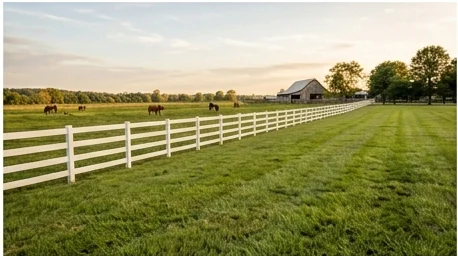
No-Climb Horse Fencing in Putnam & White County, TN
No-climb and woven-wire horse fencing across Putnam and White County, TN. Built for rocky ground, not general farm fence. Free estimates.
If you've already fenced cattle out here, you know the drill: field wire, decent post spacing, corners set deep, done. Horses change the math. A steer that gets tangled in a wire will usually fight it and back off. A horse in the same spot tends to panic, and panic is where the injuries happen. That's why the fence itself has to be a different animal, and why how it's built matters as much as what it's built from.
Why can't I just use the same fence I'd use for cattle?
Cattle fence is built to contain weight and pressure. Horse fence has to do that and also account for an animal that reacts fast, kicks high, and paws at things with its front feet. A wire spacing that's perfectly fine for a cow can catch a horse's hoof or shoe when it reaches through to graze the other side, or when it strikes out at another horse across the line. Barbed wire is the clearest example of the gap between the two. It's common on cattle operations throughout White and Putnam County farm ground, and it works fine there because cattle don't panic against a fence the way horses do. Put a spooked horse into barbed wire and you're looking at torn hide, tendon damage, sometimes worse. It's not a fence you build for horses, period.
Horses are also more particular about what they can see. They're visual animals, and they test a fence line with their mouths and feet more than cattle do. A fence that's hard to see, or that has a top edge a horse can't judge distance from, gets tested more often and gets damaged more often. That's part of why smooth top rails and visible sight-lines matter more in horse fencing than in a straight cattle line.
What actually holds up for horses around here?
A few systems show up again and again on working horse ground in this part of the state, and each one solves the hazard problem a different way.
Woven wire mesh, sometimes called no-climb wire, is the standard replacement for barbed wire on horse property. The openings are small and square instead of the large diamond pattern you see on field fence, so there's much less chance of a hoof or shoe punching through and getting stuck. It's common to run a wood board or an offset electric wire along the top of a no-climb line. That top rail does two things: it gives the horse a clear visual line to judge, and it keeps them from leaning or reaching over the mesh, which is where a lot of wire damage starts.
Wood and vinyl post-and-rail is the other fence you'll see on horse farms in the Upper Cumberland, and it's popular for a simple reason: there's no wire at all in the horse's space, so there's nothing to catch a hoof on and very little chance of a cut. It's also the easiest fence for a horse to see and respect. The tradeoff is that rail fence alone doesn't stop a determined horse from pushing through if it's spooked hard enough, so some owners pair it with a strand of electric wire set back from the rail as a psychological barrier rather than a physical one.
High-tensile electric shows up too, usually on larger acreage where running wood rail the whole perimeter isn't practical. It works, but it only works on a horse that's already been trained to respect an electric line. Put an untrained horse against hot wire for the first time and you can get a bad reaction, so this isn't the system to reach for if you're fencing green horses or a boarding situation with animals you don't know well.
| System | Best for | Watch for |
|---|---|---|
| Woven/no-climb wire + top rail | Perimeter and cross-fencing on working farms | Needs a visible top rail or offset wire so horses see it |
| Wood or vinyl post-and-rail | Paddocks, areas near barns, high-visibility lines | Rail alone won't stop a hard push, so it's often paired with electric offset |
| High-tensile electric | Large acreage, budget-conscious perimeter runs | Only effective on horses already trained to respect it |
Does the ground around Cookeville change how this fence gets built?
It changes the install more than it changes the material choice. Putnam County straddles the Eastern Highland Rim and, on its eastern edge, the Cumberland Plateau, and the soil here is part of the Bodine-Baxter-Mountview association: rocky, cherty subsoil that's a different animal from the deeper, softer ground you'd find over in the Nashville Basin. Dig a post hole out here and you'll usually hit chert fragments or shallow bedrock well before you hit the depth you actually need.
That matters more for horse fence than it does for a lot of other fencing, because horse fence has to survive an animal leaning into it, rubbing against it, or hitting it at speed if something spooks them. A cattle fence with a slightly shallow post might sag a little and still hold. A horse fence with a shallow post is a fence that leans, then loosens, then fails right when an animal puts real weight into it. On a woven wire line especially, tension carries the whole run: one weak corner or line post can let the entire stretch of wire go slack, and slack wire is exactly the kind of thing a horse's leg can end up in. It's one more reason a lot of horse owners lean toward split rail construction for paddocks and high-traffic areas, since there's no tensioned wire to go slack in the first place.
A contractor who hits chert and just keeps driving the post to whatever depth the rock allows is setting up a fence line for trouble. The right move is to work through or around the resistance, whether that means a different auger approach, hand-digging problem spots, or adjusting spacing so the posts that do go in are set properly. We've written more on how this ground affects post-setting if you want the longer version.
How deep and how solid do the posts actually need to be?
There isn't a separate spec just for horse fence versus other fence on this front. What changes is how little margin for error you have. Corner and gate posts are the ones carrying the most load on any wire fence, and they're the posts that most need concrete and full depth rather than a shortcut. We hold to standard depth and concrete guidelines on every job, rock or no rock, and you can see the specifics on our post depth and concrete standards page. On horse property, we pay extra attention to line posts too, since those are the ones a horse is most likely to lean on day after day.
If you're planning wood or vinyl rail instead of wire, the same logic applies to every post along the run. A rail fence with even a few loose posts starts to rack and gap, and gaps are exactly what a bored or spooked horse will find.
What should I ask a contractor before they start my horse fence?
Ask what wire or rail system they're planning and why. Ask how they handle post holes when they hit rock, since that's close to guaranteed on most lots in this area. Ask whether they're running a top rail or offset wire on a woven wire line, since that's the detail that keeps horses from testing the fence in the first place. A contractor who's done horse fence before will have straight answers to all three without you having to push.
It's also worth asking whether they've fenced horses specifically. Cattle work and general property-line work use overlapping materials, which you can see covered on our Putnam County fence installation page, but the judgment calls around wire gauge, top rail height, and post spacing for an animal that reacts the way a horse does are a different skill than running a straight cattle line.
Frequently asked questions
Can I use standard field fence for horses if I add a top rail?
A top rail helps with visibility, but it doesn't fix the mesh spacing underneath it. Large-diamond field fence still leaves an opening a hoof can catch in when a horse paws or reaches through low to the ground. Woven no-climb wire, which uses a tighter square mesh, is built specifically to close that gap.
Is electric fence safe for horses on its own, with no physical barrier?
It can work, but only for horses that already understand what the wire is and respect it. A horse that's never encountered hot wire before can run through it in a panic rather than away from it, especially in a new environment. Most owners pair electric with a visible physical rail or wire, at least until every horse on the property has been introduced to it safely.
Why does my fence line keep sagging in one spot even though the rest holds fine?
On a tensioned wire fence, the whole line depends on its corner and line posts holding. One post that was set shallow, whether from hitting rock during install or just age, can let that section of wire go slack even if every other post is solid. That's usually a sign to have the posts on that stretch checked rather than just re-tensioning the wire.
Do I need a different fence for foals than for adult horses?
The same hazards apply, just with less margin. Foals are smaller, more prone to slipping through gaps that wouldn't concern an adult horse, and just as capable of panicking into a fence line. A properly spaced woven wire or rail system built to keep adult horses safe generally keeps foals safe too, but it's worth mentioning foals specifically when you're talking through your layout with a contractor.
If you're planning a horse fence anywhere in the Upper Cumberland, the free on-site estimate is the place to sort out which system fits your ground and your animals. Reach out through our contact page or call (931) 651-8856 and we'll walk the property with you before anything gets quoted.
Request a Free Estimate
Fill this out and we'll get back to you, or call or text (931) 651-8856.