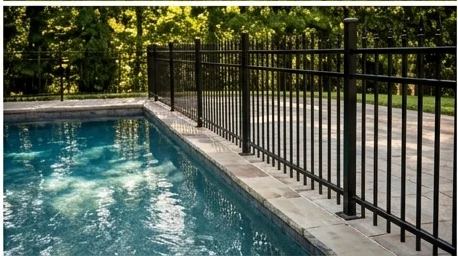
Pool Fence Installation in Cookeville, TN
Pool fence installation in Cookeville, TN. Ornamental aluminum barriers, self-closing gate hardware, and who sets the requirement for your address.
Putting a pool in at your own house changes what a fence is for. Every other fence on the property is there for privacy, for the dog, or for the look of the place. The fence around water is a barrier, and a barrier is a regulated object. It gets measured. A pool fence in Cookeville has to satisfy whichever office has jurisdiction over your parcel.
A pool enclosure is a dimensional job and a privacy fence is not
Build a privacy fence slightly shorter than planned and nobody notices. Build a pool barrier short of the requirement and it fails, no matter how straight the line or how well the posts are set. It is judged against a written specification, and that specification does not care how good the workmanship is.
The regulated elements are consistent in kind even though the numbers vary by jurisdiction. A minimum barrier height. A maximum opening between vertical members, which keeps a small child from slipping through. Rules about horizontal rails and anything else that turns the fence into a ladder. A required gate swing direction, a required latch position, and a requirement that the gate closes and latches on its own. Every one is pass or fail, which is why the specification comes before the material order.
Where the barrier requirement actually comes from
Three approvals can apply to the same pool and they do not talk to each other. The barrier requirement comes from the jurisdiction your property sits in. Inside Cookeville city limits, that is the City of Cookeville Planning Department. On unincorporated land, the Putnam County Codes and Planning Department. In Algood, Baxter, or Monterey, the town has its own office and you ask there. Sparta and Livingston work the same way. Ask for the residential pool barrier specification in a form you can print and hand a contractor.
Second, a fence permit is its own thing. The barrier spec says what the fence has to be. The permit governs where it may go. Our guide to fence permits across the Upper Cumberland covers who to call for which parcel.
Third, if your subdivision has covenants, the HOA has an opinion about material, color, and height, independent of code. Nobody can tell you what yours requires without reading them. An HOA cannot waive a safety requirement and a jurisdiction will not overrule a covenant, so a workable design satisfies both.
Why ornamental aluminum ends up around most pools
Picket spacing on ornamental aluminum is manufactured rather than built. Panels come off the line with the same gap between every picket, so the spacing you specify is the spacing you get across the whole run. For a dimension that gets measured at inspection, that removes a variable.
Aluminum also does not rot and does not rust. The fence lives in splash-out, in chlorinated water tracked over the deck, and in wet grass all summer. Powder-coated aluminum handles that and steel eventually does not, one of the splits in our comparison of wrought iron against aluminum. Panels can also be specified without a climbable profile, since horizontal rails a child can use as a step are a common way an otherwise correct fence becomes a problem.
What matters most day to day is the sightline. An open picket fence lets you see the water from the kitchen window, from the deck, from the driveway. Supervision is what prevents drownings, and a barrier you cannot see through works against it. More on the material on our ornamental iron and aluminum fencing page.
What the alternatives get right and where they fall short at a pool
| Material | Where it helps | Where it works against you |
|---|---|---|
| Ornamental aluminum | Manufactured picket spacing, no rot or rust, open sightline to the water | Costs more than chain link, and no privacy screen on its own |
| Chain link | Inexpensive, flexible post spacing, sees through fine | The fabric is a ladder, usually enough to make it the wrong call at a pool |
| Wood privacy | Screens the yard from neighbors and blocks wind off the water | You cannot see the pool through it, a real supervision problem |
| Vinyl | No rot, no repainting, holds up to splash-out, comes in picket profiles | Spacing varies by product line, so check the panel against the requirement |
Chain link draws the most questions because the price is attractive and the fabric is see-through. The trouble is that diamond mesh gives a foot purchase all the way up. There are places where chain link is exactly right, and a pool at a house with young children is usually not one of them.
Wood is the opposite failure. A solid wood privacy fence makes a fine perimeter and a poor pool barrier, because it removes your ability to glance at the water. Some homeowners end up with both, a privacy fence on the line and an ornamental enclosure around the water. Vinyl works in a picket configuration if you verify the spacing on that product line, since vinyl profiles are not standardized the way ornamental panels tend to be.
The gate hardware is the part most likely to get cheapened
The fence run is the easy half. The gate is where pool enclosures fail, and gate hardware is the line item people trim when a quote runs high.
A pool gate needs hinges that close it on their own from any open position and a latch that engages by itself. Not a latch someone remembers to throw. Self-closing and self-latching are two separate functions and both have to work without a person in the loop, because the whole point is the afternoon nobody was watching the gate. Spring tension drifts, so checking that the gate closes and latches from a partly open position is a monthly habit worth having, the same way you check the chlorine. Latch position is regulated so a small child cannot reach it, so do not eyeball that one. Our gate hardware guide covers how hinges, latches, and posts work together.
A gate is also a lever, working its post every time it swings. Gate posts carry more load than any other post in the fence, and a gate post that moves takes the latch out of alignment.
Cookeville ground, and why post layout happens before the concrete
The soil around Cookeville is cherty limestone residuum, which in practice means chert and shallow bedrock. A post hole can stop on rock while the next one along the same run digs clean. Rock here is unpredictable hole to hole, which is why post depth is most often gotten wrong on Upper Cumberland fence work. Our page on setting posts in rocky Putnam County soil gets into how that is handled.
Pool projects add a constraint ordinary fence work does not have. A pool means a deck and a deck means concrete. If the fence line runs near the deck edge, post locations have to be settled before the pour. Once a slab is down, a post that needs to land where the slab is means coring concrete or shifting the fence line, and shifting the line can put you outside a setback.
The order that works is specification first, enclosure laid out second, post locations marked third, deck poured fourth. Pool and fence work are separate trades, and nobody coordinates that unless the homeowner does.
How to plan pool fencing in Cookeville without backtracking
- Get the residential pool barrier specification in writing from the office with jurisdiction. City of Cookeville Planning inside city limits, Putnam County Codes and Planning outside, or the town office in Algood, Baxter, Monterey, Sparta, or Livingston.
- Pull your HOA covenants, and find out whether an architectural committee approves material and color.
- Confirm the fence permit requirement and any setbacks or easements on the parcel.
- Choose material against that specification rather than against a picture.
- Lay out the enclosure and mark post locations before the pool deck is poured.
- Name self-closing hinges and a self-latching mechanism on the quote, so hardware is not a substitution someone makes later.
Anyone quoting pool fencing in Cookeville should be asking which office you talked to and what the specification says. A quote silent on barrier requirements or gate hardware is worth a question. Our page on reading a fence estimate covers what belongs on a written quote, and you can start a free on-site estimate once you have your specification.
Frequently asked questions
How tall does a pool fence have to be in Cookeville?
There is a required minimum and the number depends on which jurisdiction your property falls under. Ask the City of Cookeville Planning Department for a city address, or Putnam County Codes and Planning for unincorporated county. In Algood, Baxter, or Monterey, ask that town's office. Get it from them rather than from a contractor, a neighbor, or a website.
Can my existing privacy fence count as the pool barrier?
Sometimes a perimeter fence serves as part of an enclosure and sometimes it does not, depending on the specification and on how the fence, the house, and the water sit relative to each other. The office with jurisdiction answers that. Raise two things with them: existing gates rarely have self-closing and self-latching hardware, and a solid fence gives you no view of the water.
Does the pool contractor handle the fence?
Usually not. Pool and fence installation are separate trades, and the barrier is often left to the homeowner to arrange. That is why post layout gets missed until the deck is poured. Ask your pool contractor early whether the fence is in their scope.
What about a pool at a house I rent out on a nightly basis?
The specification is the same but the risk profile is not, because guests swim without an owner present and without knowing the property. That situation is covered on our page on fencing a property you rent out.
Request a Free Estimate
Fill this out and we'll get back to you, or call or text (931) 651-8856.