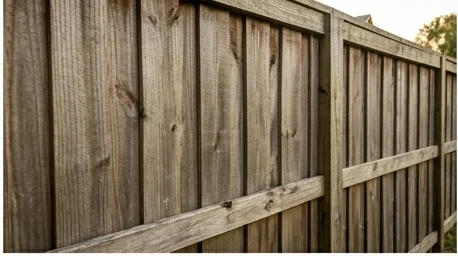
Board-on-Board Shadowbox Fencing
Board-on-board (shadowbox) wood fencing: a two-sided finished look with airflow, good for shared property lines. Free estimates.
Cookeville Fence Co. builds board-on-board as one of several wood privacy options, and the short version on our wood fencing page is accurate as far as it goes: boards overlapped for privacy with airflow. What that one line doesn't get into is why a homeowner would pick board-on-board over a standard solid privacy fence in the first place, and where around the Upper Cumberland it makes sense. That's what this page covers.
How is board-on-board actually built?
A standard solid privacy fence is built with boards attached to one side of the horizontal rails, edge to edge, so one face is smooth and finished and the other shows the rails and post backs. Board-on-board flips that setup. Boards get attached to alternating sides of the rail, or spaced with a gap and then covered by a second board offset behind it, so every gap on one side is backed by wood on the other. Walk around to the neighbor's yard and you see roughly the same thing you see from your own: finished boards on both faces.
That's the trait fence people call a "good neighbor" style. It's not a marketing term invented for this page, it's standard terminology in the trade for any fence design built so both properties get a finished look instead of one side getting the boards and the other getting the rails.
On a shared property line, that split matters more than it seems like it would at first. Tennessee property law generally treats a fence built on or near a line as something both owners have to live with, and in practice most homeowners here handle it by agreement rather than survey and paperwork: you talk to the neighbor, you pick a line, somebody builds a fence. With a standard solid privacy fence, that conversation usually ends with one household getting the smooth face and the other getting a view of rails and post backs for as long as the fence stands. That's not a defect in the fence, plenty of people are fine with it, especially on a line that only one side actually uses. It becomes a sticking point when both households are going to see the fence daily, from a kitchen window, a deck, a dog run, or a spot where kids play. A board-on-board fence sidesteps the whole negotiation over who gets the "good" side because there isn't a bad side to assign.
Where does board-on-board make more sense than a solid privacy fence?
Two situations come up a lot in this part of Tennessee.
The first is a shared property line where both households are going to look at the fence every day. If you and the neighbor split a lot line, or you know they're going to be staring at fence boards from their porch or kitchen window, board-on-board avoids the conversation about whose yard gets the finished face. It's not required for a shared line, plenty of shared-line fences are standard privacy fencing, but it's the style built specifically to solve that problem.
The second is an exposed or windy site. A fully solid privacy fence is essentially a wall to moving air, and on a ridge lot, an open pasture edge, or anywhere wind gets a long unobstructed run at the fence line, that solid face is what eventually works posts loose or racks panels over time. The small gaps in board-on-board let wind pass through instead of loading up against a flat surface. You still get a privacy look from normal viewing angles, since the offset boards block sightlines, but you're not asking the fence to act as a windbreak.
A lot that catches wind is often the same lot with a ridge or a grade falling away toward a valley, since that's usually what leaves it exposed in the first place. The airflow gaps handle the wind side of that regardless of how the fence follows the ground, and the grade itself is a separate question, covered on our page on building on grade.
Does board-on-board cost more than other wood styles?
It uses more lumber per linear foot than a standard picket fence with spaced boards, and more than a single-layer solid privacy fence, since you're doubling up boards across most of the run instead of running one layer. That doesn't mean it's automatically the most expensive option on a job, site conditions, gate count, and terrain all factor into a quote too. The only way to get a real number for your yard is a free on-site estimate, and you can request one through the contact page or by calling (931) 651-8856.
What wood should board-on-board be built from?
Board-on-board describes how the boards are framed across the rail, so it works with whatever wood species you'd choose for any other wood fence style. Most homeowners in this region choose between cedar and pressure-treated pine, and the tradeoffs between those two, cost, rot resistance, how each ages, are laid out on our cedar versus pressure-treated pine comparison. Whatever species goes into a board-on-board fence still has to hold up to Cumberland Plateau freeze-thaw cycles in winter and Tennessee summer humidity, so post depth, concrete, and material selection matter as much here as on any other wood fence.
Does board-on-board work on a sloped yard?
Board-on-board can be built stepped or racked like other wood fence styles, following the grade in sections or angling the rails to follow a slope continuously. Which approach fits depends on how steep the ground is and what look you want at the transitions. We cover the general tradeoffs of building on grade on our fencing on a slope page, and for board-on-board specifically, the stepped approach tends to keep the alternating board pattern cleaner at each step than trying to rack a double-layer fence continuously down a steep grade. That's a call worth making on-site rather than guessing from a photo.
Does the airflow gap mean less privacy?
Not from a standing viewing angle at typical fence height. The boards on each side are offset from each other, so the gaps on one layer are covered by solid wood on the other layer. You lose the dead-solid wall you'd get from single-layer privacy fencing, but you don't get see-through sightlines the way you would with a picket or spaced-board fence. What you're trading away is a fully sealed surface, and what you keep is a blocked sightline.
FAQ
Is board-on-board the same as a shadowbox fence?
Shadowbox is the other common name for the same overlapping, alternating-board style. Fence companies use both terms for the same construction: boards offset on both sides of the rail so gaps on one face are backed by wood on the other.
Can board-on-board be built with any fence height?
The framing pattern itself isn't tied to a specific height. What height works best depends on what you're trying to accomplish with the fence and any local rules that apply to your property, which is worth reviewing during a site visit.
Does board-on-board need different post spacing than a solid privacy fence?
Post spacing is driven mainly by rail length and the weight the posts need to carry. A crew sizing the job will factor in the added lumber weight of the double-board pattern when setting post depth and spacing for your specific run.
Can board-on-board be built taller than a standard privacy fence?
Height rules come from your local code and, if you have one, your HOA. Board-on-board doesn't carry its own height allowance separate from solid privacy fencing. What changes with height is the framing: a taller run needs a heavier rail schedule to keep the extra board weight from sagging the line over time, which is a detail worth confirming with whoever quotes the job.
Do I still need to talk to my neighbor if I'm going with board-on-board?
Yes. Board-on-board takes the "whose side looks finished" question off the table, but it doesn't replace the conversation about where the line actually falls or who's paying for what. Those are separate issues from the fence style itself. If you're weighing board-on-board against a standard solid fence for the same shared line, our privacy fence page lays out what a single-face fence looks like on that same lot, so you can compare the two before deciding.
Request a Free Estimate
Fill this out and we'll get back to you, or call or text (931) 651-8856.