Fencing for Lake Houses and Vacation Rentals
Pool and privacy fencing for lake houses and vacation rentals near Dale Hollow, Cordell Hull, and Center Hill. Low-maintenance options.
If you own a place near Dale Hollow Lake, Cordell Hull Lake, or the Center Hill and Rock Island area and you're not living there full time, your fence has a harder job than a fence at a regular house. Nobody's home to notice a gate latch working loose or a board splitting after a wet spring. If you rent the property out on weekends, strangers are using that fence as a safety barrier around a pool or a walk down to the water, and they don't know the property's quirks the way you do. This page covers what changes about fencing when the owner isn't on site and the answer isn't a permanent one.
Why does an absentee-owned property need different fencing than a full-time home?
At a house where the owner lives every day, small maintenance problems get caught early. A gate hinge that starts to sag gets tightened the same weekend. A section of wood fence that's holding water gets noticed and dealt with before it rots through. None of that happens automatically at a second home or a rental. You might see the property once a month, once a season, or only through a property manager's photos.
That changes which material makes sense. A fence that needs periodic staining, sealing, or board replacement is a fence that depends on someone being there to do that work. If nobody local is checking on it, maintenance gets deferred, and deferred maintenance on a fence usually shows up as a loose picket, a leaning post, or a gate that won't latch, right around the time a renter's kids are running through the yard.
What fence material makes sense when you're not there to maintain it?
Wood fencing can look great around a lake house and plenty of owners want that look. But wood is also the material most dependent on upkeep: staining, sealing, and catching rot early all matter more with wood than with anything else. If you're going to be hands-off for months at a stretch, that's worth weighing against the maintenance-free options.
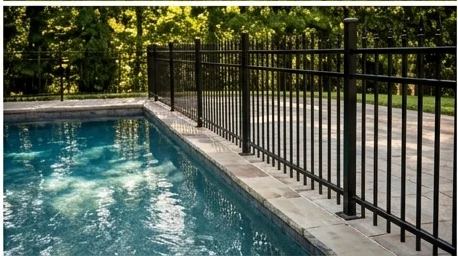
Vinyl fencing doesn't need painting or staining and won't rot, which makes it a common choice for owners who aren't around to do seasonal upkeep. For a more open, decorative look, especially around a pool or a view of the water, ornamental iron fencing or an aluminum alternative holds up without the maintenance wood demands. Our page comparing wrought iron and aluminum fencing walks through how those two options differ if you're deciding between them for a pool enclosure or a decorative perimeter.
Does a pool or dock at a rental property need a specific kind of fence?
A pool at a property you live in full time is one thing. A pool at a short-term rental is another. The people using it are staying for a few days, they don't know if the water gets deep fast, and there's no homeowner walking past twice a day to keep an eye on things. Whatever barrier requirement applies to your property, and requirements do vary by county and municipality in this area, it matters more at a rental than it would at a house where the owner is present.
Self-latching, self-closing gate hardware matters here too. A gate that a guest can prop open, or one with a latch low enough for a small child to reach, defeats the purpose of the barrier even if the fence itself is code-compliant. Don't guess at the height or gate spec that applies to your parcel. Confirm it with your county before you order materials, since a barrier that doesn't meet the local requirement can leave you exposed if something goes wrong at a property you weren't there to supervise.
Does privacy fencing matter more or less at a rental than at a full-time home?
At a house you live in, you generally know your neighbors. At a lake house or rental, the people in the next house over might be a different family every week. That changes what privacy fencing is for. It's less about a long-term relationship with the people next door and more about giving each set of renters, and yourself when you're staying there, a yard that feels private from whoever happens to be renting the neighboring property that week.
It also matters for keeping renters oriented on your property. A clear fence line around a rental helps guests understand where the yard ends, especially useful if the lot backs up to a neighboring rental, a shared access road, or land near the water where the boundary isn't obvious just by looking at the terrain.
What should I know about the land itself before fencing a lake property?
Fencing close to a reservoir isn't always a simple matter of picking a line and setting posts. Property near Dale Hollow Lake, Cordell Hull Lake, and the Center Hill and Rock Island area can carry its own setback or easement considerations tied to the shoreline, separate from whatever building code does or doesn't apply to your county. Our lakefront fencing page goes into more detail on how that plays out across the three lakes.
Ground conditions matter too. The Overton County side of this region has confirmed karst terrain, meaning documented sinkholes and sinking streams. That means unpredictable voids under the surface even where the ground looks solid, which is worth knowing before you plan post locations for a fence around a pool or a long perimeter run. If you're not sure what applies to your specific parcel, whether it's a setback, an easement, or ground conditions, our fence permits page for the Upper Cumberland is a good place to start, and from there a call gets you a straight answer for your address.
Do I need a permit for fencing at a lake house?
It depends on the county. Some counties in this area have adopted building codes that touch fence construction, and some haven't. Pickett County and the Town of Byrdstown, for instance, have both opted out of building code jurisdiction entirely, so no county or municipal building code applies to fence construction there. That's not true everywhere in the region, and it says nothing about separate shoreline setbacks or easements that might still apply regardless of building code status. Check what applies to your specific county before you finalize a layout, particularly for a pool barrier or anything near the water.
Frequently asked questions
Can a fence be installed if I'm not going to be there during the work?
Coordinating a project at a property you don't live at full time just takes some planning ahead of time on timing, gate codes, and where materials get delivered. Call (931) 651-8856 to talk through what that looks like for your property.
What's the lowest-maintenance fence option for a lake house I only visit a few times a year?
Vinyl is generally the least demanding option since it doesn't need staining or sealing. Aluminum and ornamental iron-style fencing are also good choices if you want something more open around a view or a pool without wood's upkeep.
Does a rental property need a taller or different fence than a regular house?
Not necessarily taller across the board, but if there's a pool, a barrier requirement may apply, and that requirement varies by county and city. Confirm what applies to your property directly rather than assuming a neighbor's fence height is the standard.
Who do I ask about setback or easement rules on lake property?
Your county's building or zoning office can tell you what applies to your specific parcel. A call to (931) 651-8856 can help you figure out the right office to ask if you're not sure where to start.
Ready to plan fencing for your lake property?
A low-maintenance perimeter, a pool barrier, or privacy fencing for a rotating cast of renters all take some different thinking than a fence at a full-time home. Reach out or call (931) 651-8856 to talk through what your property near Dale Hollow, Cordell Hull, or Center Hill needs.
If the pool is at a home you live in rather than a rental, our Cookeville pool fence page covers that side.
Request a Free Estimate
Fill this out and we'll get back to you, or call or text (931) 651-8856.