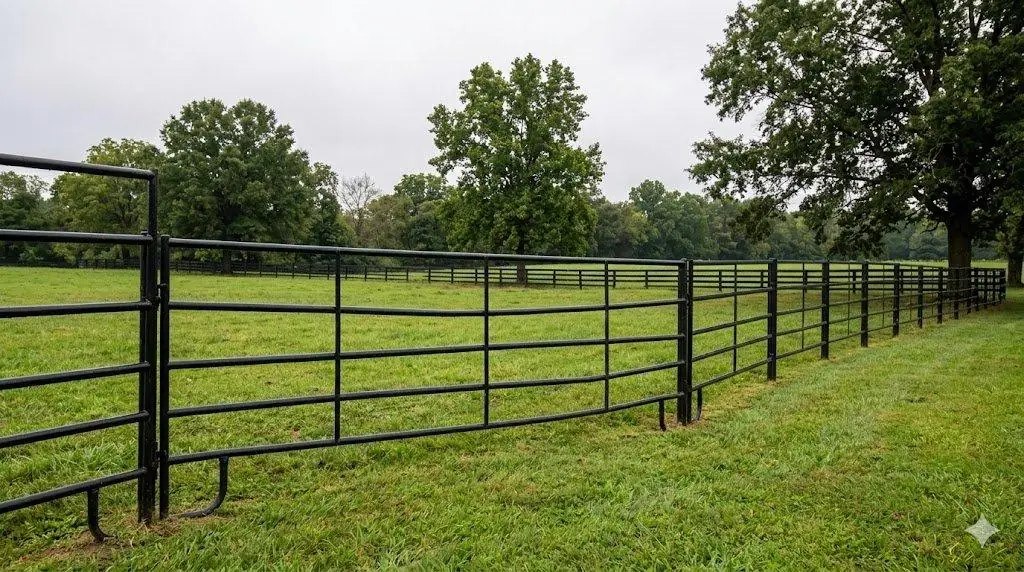
Fence Repair in Carthage, TN
Fence repair for Carthage river bottoms, hillside pasture, and town lots, from flood-loosened posts to sagging farm gates.
Carthage sits where the Caney Fork meets the Cumberland River, and Cordell Hull Dam is about five miles upstream. Around town, fence runs across flat river bottom that floods from time to time and climbs steep, rocky pasture hills. Both kinds of ground loosen posts, for different reasons.
The breaks are ordinary ones: posts leaning after high water, runs knocked down by drift or a tree, gates that drag. Before Brian replaces anything, he works out whether the post sits in wet bottomland or in clay and rock on a hillside, because the fix differs.
What does high water do to a fence in the Carthage bottoms?
The bottomland along the Cumberland and the Caney Fork is mapped mostly as deep silt loams laid down by the rivers, such as Arrington, Lindell, and Egam. Woven wire and board fence catch limbs, cornstalks, and trash, and the weight of that drift pulls wire off its staples and pushes posts downstream. Where water moved fast, at a corner or a low gap, it can scour soil from around a post until little is left to hold it.
The Town of Carthage mails a letter to owners in areas that have flooded several times. If you have gotten one, walk your fence after every high river and look for drift on the wire, posts tilting downstream, and silt banked at the base.
Why does a post lean in a wet bottom or on a clay hillside?
In the bottoms, the trouble is water held in the soil. The soil survey lists a seasonal wet layer in Lindell soils about 15 inches down from December through March, and about 23 inches down in Egam, which turns to clay below that depth. A post set there spends every winter with its lower end in saturated soil, where wood rots and steel rusts faster and soft ground lets a post tip under load. Gravel at the bottom of the hole, concrete sloped away from the post, and ground-contact posts count for more on a bottomland lot. The basics are in how runoff and erosion undercut fence posts.
The hills bring a different problem. The most extensive soil mapped in Smith County is the Ashwood-Mimosa-Rock outcrop complex on 15 to 45 percent slopes. It is clayey soil formed from limestone, with rock showing at the surface in places and bedrock as shallow as about three feet. The same survey lists eastern redcedar among the trees on those hill soils, so a hillside fence row can need cedar cleared before a post gets reset. A post hole there can hit rock before proper depth, and the clay holds water against the post after rain. Our page on building and repairing fence on a slope explains how a run is set to follow grade.
So the first thing Brian checks on a leaning Carthage post is the hole: how deep, sitting in what, and does water stand there in winter? A new post in the same wet or shallow hole will lean again. Our post depth and concrete standards page lays out what a proper setting looks like.
Who do you ask before repairing a fence in Carthage or Smith County?
Whether a repair needs a permit is for the office over your address to say, and around Carthage there are four. Carthage Town Hall is at 314 Spring Street, (615) 735-1881. The town will also tell you at no charge whether a lot is in the flood hazard area on the current flood map, with the zone and base flood elevation if shown.
The Smith County Planning Office covers the county outside the three city limits at (615) 735-3418. If a repair turns into a new fence on a new line, especially in a mapped flood zone or along a road, call before posts go in. Our county-by-county guide to fence permits shows how the rest of the region compares, and the Smith County fence installation page covers the wider county. Downtown has the Smith County Courthouse, which is on the National Register, but we have not verified a historic district fence ordinance there. Ask City Hall if you own property downtown.
What changes when the fence has to hold cattle in Smith County?
The 2022 Census of Agriculture counted 758 farms averaging 167 acres, close to 47,000 acres of pasture, and 21,816 cattle and calves, along with corn and soybeans on the flatter ground. When a pasture fence goes down, the problem is cattle on the road or in a neighbor's crop, so a farm repair starts with closing the line.
Pasture fence gives out at the wire and the bracing: woven or barbed wire goes slack, line posts break, a corner or H-brace pulls out of soft ground, and gates sag after cattle lean on them. A crossing over a creek or a low swale takes a beating every high water, so it can make sense to build that short piece to be cleared and fixed on purpose. Our split rail and farm fence page covers the farm materials.
Reset the posts or rebuild the run on Carthage bottoms and hills?
On a Carthage property, ask whether the damage sits in one place or the ground under the whole line is causing it.
| What you see | What it points to |
|---|---|
| Drift and silt piled against one stretch, posts still firm | Repair: clear the debris, then restretch or refasten wire and boards |
| A few posts tilting downstream at a low corner after high water | Repair: reset those posts deeper, with gravel at the base and fresh bracing |
| Wood posts soft at the ground line along most of a bottomland run | Replace the run with posts rated for ground contact |
| A corner or H-brace pulled loose while the line posts hold | Repair the brace assembly, since it carries the wire tension |
| The same low section washed out after each of the last few floods | Rebuild that piece on a different line, or as a section made to be cleared |
| Hillside posts leaning where the holes hit rock early | Reset at proper depth, or rebuild if most posts on the hill were set shallow |
Our article on signs a fence needs repair or replacement has more detail, and the Carthage fence installation page covers starting over.
What happens after you call about a Carthage fence?
- Tell us where the fence is. Which town or part of the county, and whether the line runs across river bottom, a hillside, or a town lot. Photos by text help.
- Tell us what hit it. High water, a storm, a tree, cattle, or age. If it flooded, how high did the water come on the fence?
- Brian walks the line. He checks how each post is set, the soil at the base, where water runs and stands, and how far the damage reaches past the obvious break.
- Brian writes up what he finds. Which sections to repair, which to rebuild, what material will match, and which office to check with if the work changes the line.
- The work happens when the ground allows. Wire, board, and gate fixes go ahead in most weather. Post resets in saturated bottomland wait for firmer soil, unless cattle are getting out, in which case we close the line first.
Coming out to look costs you nothing, and the Tennessee fence pricing breakdown shows what goes into a number. A post problem usually comes down to the hole and the water, and neither shows up over the phone.
Fences we repair in and around Carthage
On town lots, that means wood privacy fence with boards cupped by moisture or posts gone soft at the ground, chain link with fabric bent by drift or a limb and top rail pulled loose, and vinyl panels cracked by impact or knocked out of their posts. On county acreage it is woven wire, barbed wire, board, and split rail, plus the bracing that keeps it tight. Walk gates, driveway gates, and pasture gates are covered on our gate installation and repair page, and the full list of repair work is on our fence repair services page.
Farm fence repair also covers electric-fence insulators, steel T-posts bent by cattle or a fallen limb, and woven wire stretched by deer.
For lake property, see our guide to fencing near Cordell Hull Lake.
Questions Carthage owners ask about fence repair
Should I fix my fence right after the river goes down?
Clear drift off the fence once it is safe, since that weight keeps pulling on the posts. Wait to reset posts until the ground firms up, because a post set in freshly flooded soil can settle as it dries.
Does homeowner's insurance cover a fence damaged by flooding?
Ask your agent. The Town of Carthage's flood notice points out that a standard homeowner's policy does not cover flooding, and flood insurance is a separate policy. Wind or a falling tree is a different claim. Our guide to fence storm damage and insurance claims in Tennessee lists the photos to take before cleanup.
Can you repair a fence that runs along the road or through a ditch?
Yes, but call the right office first. The Town of Carthage asks owners to check permit requirements before they build, fill, or regrade within any easement or right-of-way. Outside town, ask the Smith County Planning Office.
Do you work in South Carthage, Gordonsville, and the rest of Smith County?
Yes. We repair fences in Carthage, South Carthage, Gordonsville, and the rural parts of Smith County, and up the Cumberland in Jackson County, where we cover fence repair in Gainesboro. Fences somebody else built are fine too.
Get a repair estimate in Carthage
To have Brian walk your fence, call or text him at (931) 651-8856 or write through our contact form with the material, how much fence is down, and what you think caused it.
Request a Free Estimate
Fill this out and we'll get back to you, or call or text (931) 651-8856.