Commercial Fence Installation in Cookeville & Crossville, TN
Commercial and light-industrial fencing for equipment yards, self-storage, and nurseries across Cookeville, Crossville, Sparta and McMinnville.
Commercial fencing out here looks different than it does around a Nashville office park. The businesses that need a secure perimeter in Cookeville, Crossville, Sparta, and McMinnville are equipment yards, storage facilities, and growing operations. There's no stretch of named office parks or planned business districts in this part of the state, and we're not going to pretend there is. What we do have is real, working commercial ground that needs fencing built for how it actually gets used. Call (931) 651-8856 to talk through what your property needs.
What counts as commercial fencing around here
Three types of properties make up most of the commercial and light-industrial fencing work in this region. Contractor and equipment yards need a perimeter that keeps trucks, trailers, and materials secure overnight and on weekends. Self-storage facilities need fencing that controls access to the whole site rather than to individual units alone. Nursery and greenhouse operations need fencing that does double duty as production infrastructure and boundary line at once.
Each of these has different priorities. An equipment yard cares about deterring theft and controlling one or two access points. A self-storage facility cares about a continuous perimeter with a gate system tenants can use themselves. A nursery cares about keeping growing blocks separated and equipment traffic on defined lanes. The fence has to match the job it's doing, and that's a conversation we have on-site before anything gets priced.
None of these are complicated builds in the sense of exotic materials or unusual engineering. They're complicated in the sense that the layout decisions matter more than they do on a house lot. Where the gate goes, how wide it needs to be, whether the fence needs to be continuous or can have breaks: those choices get made by walking the property in person.
Chain link for yards and storage sites
For a contractor's yard or a self-storage property, chain link fencing is usually the right call. It's fast to install across long runs, it doesn't block sightlines, which matters if you want to see the whole yard from the office, and it can be built to whatever height the site needs. Galvanized chain link holds up well through Tennessee winters and summers alike, and it doesn't need the maintenance a wood fence would over the same square footage.
Height and gauge both matter more on a commercial site than a residential one. A yard storing equipment and materials generally wants taller fencing and heavier gauge wire than a backyard dog run. We walk the property line with you and talk about what's actually being protected before recommending a spec. A lot with parked trailers and heavy equipment gets treated differently than a storage facility with mostly foot traffic between units.
Barbed wire or privacy slats can get added to chain link on some commercial sites depending on what the property needs. That's a conversation for the site visit, since it depends on visibility from the road, what's being stored, and how the property owner wants the fence line to read from outside.
Ornamental iron where it makes sense
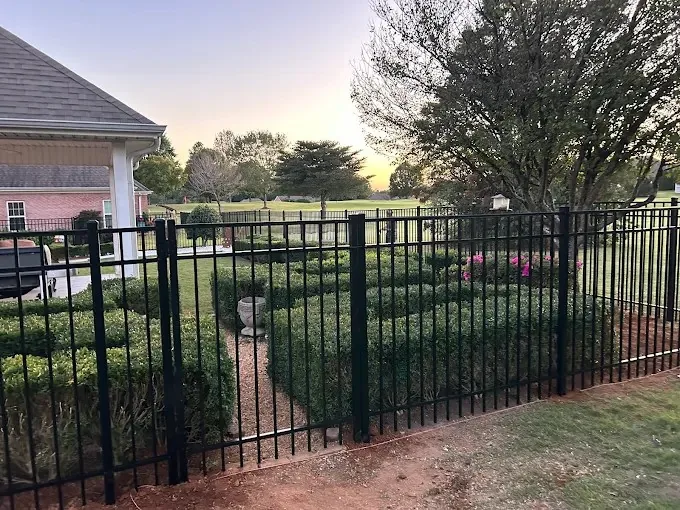
Ornamental iron fencing shows up less often on light-industrial sites, but it has a place. A business with a street-facing entrance or an office portion of the property sometimes wants something with more presence than chain link at that one section, while keeping chain link around the working yard behind it. Iron costs more per foot, so it tends to get used selectively at an entrance or frontage rather than around an entire perimeter.
We won't push iron fencing on a property that doesn't need it. If chain link does the job for your whole site, that's what we'll recommend. If you've got a front office or a customer-facing entrance that would benefit from a more finished look, we can spec iron there and chain link everywhere else. Mixing materials on one property is common on commercial jobs for exactly this reason.
Nursery and greenhouse fencing
McMinnville and Warren County are known as the Nursery Capital of the World. Warren County has more than 400 nurseries and ranks first in Tennessee for nursery, greenhouse, and floriculture sales. If you run a growing operation anywhere in the Upper Cumberland, the fencing considerations that apply in Warren County apply to you too.
Nursery fencing has to work as part of the production system. It protects field-grown and container stock from wandering deer and stray traffic, it keeps equipment on defined lanes so tractors and carts aren't cutting across growing beds, and it separates wholesale growing blocks from retail or customer-facing areas. That changes where gates go, how wide they need to be for equipment, and which material makes sense for which section of the property.
A retail-facing entrance at a nursery often gets a more finished look, sometimes ornamental, while the production blocks behind it run chain link built for equipment access rather than curb appeal. We cover this layout thinking in more depth on our nursery and ornamental fencing page, and the same approach applies to growers at scale in Warren County and smaller operations elsewhere in the region.
Gates and access points
A perimeter fence is only as secure as its gates. Commercial and light-industrial sites usually need at least one gate wide enough for trucks or trailers, sometimes a separate walk gate for daily foot traffic, and hardware that can take repeated daily use without failing. Self-storage properties often need a gate system tenants operate themselves, which means the hardware and layout have to hold up to constant use by people who aren't on your payroll.
Gate width is one of the most common things that gets underplanned on commercial sites. A gate sized for a pickup truck won't work if a delivery truck or a piece of towed equipment needs through it once a month. We ask about every vehicle that regularly comes onto the property, including the occasional ones, before recommending a width.
Our gate installation and repair services cover both new gate builds and fixing gates that are sticking, sagging, or not latching right on an existing fence. If your current perimeter fence is solid but the gate is the weak point, that's a smaller job than replacing the whole line, and it's worth a call before you assume the whole fence needs to come out.
| Property type | Typical priority | Common material |
|---|---|---|
| Contractor / equipment yard | Secure perimeter, controlled access points | Chain link |
| Self-storage facility | Continuous perimeter, tenant-operated gates | Chain link |
| Nursery / greenhouse | Working perimeter, defined equipment lanes | Chain link, some ornamental at entrances |
Where we work
We cover commercial and light-industrial fencing across Cookeville, Crossville, Sparta, and McMinnville, along with the surrounding Upper Cumberland counties. Our full fence installation services page has more detail on how we approach materials and layout across residential and commercial jobs alike.
We're a newer business in this market, and we're upfront about that. We haven't got a stack of completed commercial jobs to point to yet. What we do have is a straightforward process: we come look at your property, talk about how it's actually used day to day, and give you a plan and a free estimate based on that instead of a generic template pulled off a price sheet.
If you're weighing quotes from a few contractors, ask each one to walk the property with you before pricing it. A quote built from a satellite photo or a phone call tends to miss the gate widths and traffic patterns that actually determine whether a commercial fence works once it's in the ground.
Frequently asked questions
Do you install fencing for equipment yards and contractor lots?
Yes. Chain link is the most common material for this kind of site because it covers long perimeters economically and holds up to daily vehicle and equipment traffic. We'll walk the property with you to figure out height, gauge, and gate placement.
Can you fence a self-storage facility?
Yes. Self-storage perimeters need a continuous fence line and gate hardware built for tenants operating it themselves multiple times a day. We size the gate system to how the property is actually used.
Do you work with nursery and greenhouse operations?
Yes, including growers in and around McMinnville and Warren County, the Nursery Capital of the World. Nursery fencing has different needs than a standard perimeter: it has to protect stock, keep equipment on defined lanes, and separate growing blocks from retail areas. See our nursery fencing page for more.
How do I get a quote for a commercial property?
Call (931) 651-8856 or use our contact page to set up a free on-site estimate. We'll walk the property, talk about how it's used, and put together a plan based on what we see.
Request a Free Estimate
Fill this out and we'll get back to you, or call or text (931) 651-8856.